
Pool Service Before Summer: What a Visit Should Include, and Comparing Pool Companies
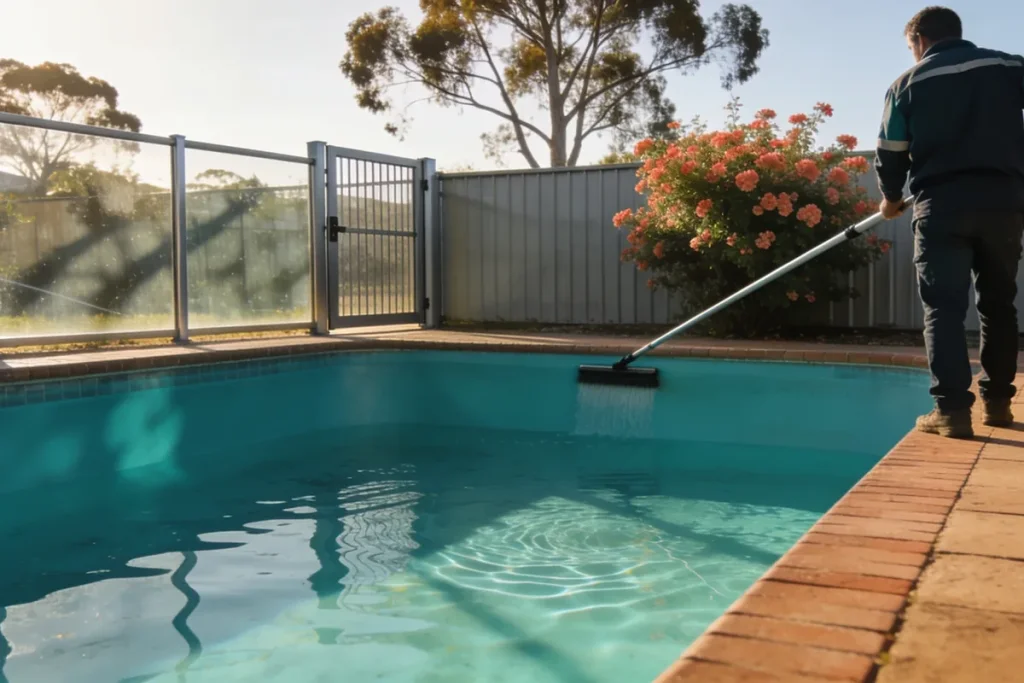
Every spring a share of backyard pools comes out of winter green. The owner then faces two decisions in quick succession: how to get the water back, and whether to pay someone to keep it that way. Broadly there are two routes, a one-off recovery visit followed by do-it-yourself maintenance, or a regular service arrangement with a pool company. Either can be the right answer. The difficulty is that the price on the flyer is rarely the whole bill, and two companies offering “a pool service” may be describing quite different amounts of work.
This guide defines what a complete service visit should include, separates the labour from the chemicals, compares a one-off opening with a contract, and sets out a method for comparing two pool companies on the same terms. It closes with the one check a pool cleaner does not perform: the safety barrier.
What a complete service visit includes
A useful starting point is a written definition of the visit. Where a company cannot say what its standard visit includes, it is difficult to compare it with anyone else. A complete visit should cover the following tasks:
- A water test, with the readings written down as well as acted on.
- Chemical adjustment to correct the readings, with the products and quantities recorded.
- Skimming the surface, brushing the walls and floor, and vacuuming.
- Emptying the skimmer basket and the pump basket.
- Backwashing or cleaning the filter as needed.
- Checking the chlorinator or salt cell, the pump and the other equipment for faults.
- A written job card recording what was done, left with the owner or sent afterwards.
Two points in that list carry more weight than the others. The first is the recorded water test. Readings that are written down allow an owner to see whether the water is trending in one direction across visits, and to check that the chemicals added match what the readings called for. The second is the job card. It is the only evidence an owner who was not home has that the brushing and vacuuming took place.
Time on site is not a measure of quality by itself, but it sets a limit. A visit that covers every task above cannot be completed in a few minutes. Where a job card lists tasks that the time spent could not have accommodated, that is a reasonable question to put to the company.
It is also reasonable to ask a company which ranges it aims for, for pH and for sanitiser. This guide does not set out target numbers, because they depend on the pool and its equipment. The purpose of the question is to establish whether the technician works to a stated target and can explain it.
Labour and chemicals, billed separately
A pool service bill usually has two components: the call-out or visit fee, which pays for the technician’s time and travel, and the chemicals added during the visit. These should be itemised separately, and the job card should name each product and the quantity used.
The reason for insisting on this is practical. A visit fee viewed alone says little about the total cost, because the chemical component can vary from one visit to the next. A low visit fee combined with heavy chemical charges is a pattern worth watching for. Where products and quantities are listed, an owner can see whether the chemical spend is consistent across visits and whether it tracks the recorded readings. Where they are not listed, there is no basis for that comparison.
Owners can also test the water themselves between visits, using a home test kit. This does not replace the service, but it gives an independent reading against which the technician’s figures can be compared, and it makes a sudden jump in chemical use easier to question.
The same principle applies to most recurring home services: the bill should itemise what each visit includes. The approach set out in this site’s guide to vetting a pest control company follows the same logic.
A one-off spring opening or a service contract
The choice between a single visit and a regular arrangement depends mainly on how much of the work the owner is prepared to do. The table below sets out the two options.
| Option | Suits | What to ask |
|---|---|---|
| One-off spring opening | Owners who will maintain the pool themselves once the water is clear | Does the visit include recovery from green water, a full equipment check and a written list of any faults? How many return visits, if any, are included? |
| Service contract | Owners who want the pool maintained through the season without doing it themselves | How often (weekly, fortnightly or monthly)? What is included in each visit? Are chemicals billed at cost or with a mark-up? What are the cancellation terms? Who covers the pool when the regular technician is away? |
A one-off opening is typically a heavier visit than a routine service. Recovering a green pool may take more than one attendance, so the owner should establish in advance whether follow-up visits are included in the price or charged separately. The equipment check is the most useful part of the opening for an owner who then maintains the pool alone, because faults found in October are easier to deal with than faults found during the first heatwave.
A service contract shifts the routine work to the company, and its terms deserve the same scrutiny as any other contract. Five points should be stated in writing: the frequency of visits, the tasks included in each visit, the basis on which chemicals are charged, the cancellation terms, and the arrangements for holiday cover. A contract that leaves any of these open is difficult to enforce if the service falls short.
The first month of a contract is the best time to check it. Compare the job cards from the first few visits against the contract’s list of tasks, and the chemical charges against the readings. A gap between what was agreed and what is recorded is easiest to raise early, before it becomes the pattern for the season.
Comparing two pool companies
A comparison between two companies is only meaningful if both are pricing the same work. The method below keeps the comparison even.
- Give both companies the same description of what is needed: the pool, the frequency and the list of tasks above.
- Ask each company for a sample job card. A company that records readings, products and quantities is offering more information than one that records only the date of the visit.
- Ask whether the company holds public liability insurance, and ask for confirmation in writing.
- Ask who carries out equipment repairs, and on what terms. Some companies repair equipment themselves; others refer the work on.
The last point needs care where electrical work is involved. Wiring a new pump or heater, or other electrical work on pool equipment, is work for a licensed electrician, whoever diagnosed the fault. This site’s guide to the difference between a handyman and a licensed specialist explains how to tell which jobs fall on which side of that line.
The timing logic is the same as for air conditioning. Equipment that has sat idle through winter is best checked before the hot weather, while a fault is still an inconvenience rather than an emergency. The guide to servicing air conditioning before summer applies that reasoning to cooling systems.
When the two quotes are in, compare them in this order: scope first, then the information each job card provides, then insurance and repairs, and only then the price. A cheaper quote may simply cover less work, and the order above is what shows it.
The safety check a cleaner does not do
Water quality and barrier safety are separate questions, and a pool service addresses only the first. The fence, the gate and the self-closing and self-latching mechanisms are subject to their own rules, and in some states to their own inspection regime.
In Victoria, the position is set out by councils such as Maroondah City Council. Pools and spas capable of holding more than 30 centimetres of water must be registered with the council. The safety barrier must then be inspected and certified every four years, and Maroondah’s page explains how that cycle works for its residents.
Life Saving Victoria addressed the issue in a statement dated 10 August 2026. It said that a lack of barrier maintenance is a leading factor in toddler drownings in home pools, and it called for mandatory inspections of home pool barriers. The point bears directly on the start of the season: a gate that closed reliably last summer may not do so now.
Other states and territories run their own registers and certificates, and the requirements differ. Owners outside Victoria should check the position with their council.
A pool technician who notices a gate that fails to latch, a gap under the fence or an object that would let a child climb over should tell the owner. That is a reasonable expectation of anyone working in the yard. A technician cannot, however, certify the barrier, and a clean pool says nothing about whether the barrier complies.
Owners can do a simple walk-around themselves before the first swim. Open the gate and let it go to see whether it swings shut and latches on its own, look along the fence line for damage or gaps, and move anything near the fence that a child could climb on. None of this replaces certification where it is required, but it catches the faults that develop between inspections.
Clear water, latched gate
A pool service is easiest to judge when its scope is written down. A complete visit includes a recorded water test, chemical adjustment, skimming, brushing and vacuuming, emptying the baskets, attention to the filter, an equipment check and a job card. Labour and chemicals should be billed separately, with every product named. A one-off opening suits an owner who will take over the routine work; a contract suits one who will not, provided its terms are written down.
When comparing companies, fix the scope first and the price last. Then, separately from the service, check the gate and the fence before the first swim of the season, and in Victoria, confirm that the barrier’s four-yearly certification is current.
Sources: Life Saving Victoria, Safety recommendations ignored by Government: mandatory inspections of home pool barriers required to prevent drowning (https://lsv.com.au/media-centre/news/safety-recommendations-ignored-government-mandatory-inspections-home-pool-barriers-required-prevent-drowning); Maroondah City Council, Swimming pool and spa registration and fencing (https://www.maroondah.vic.gov.au/Residents-property/Swimming-pool-and-spa-registration-and-fencing)