
Choosing a Dog Groomer Your Dog Will Tolerate: The Trial Visit, the Handling and the Price
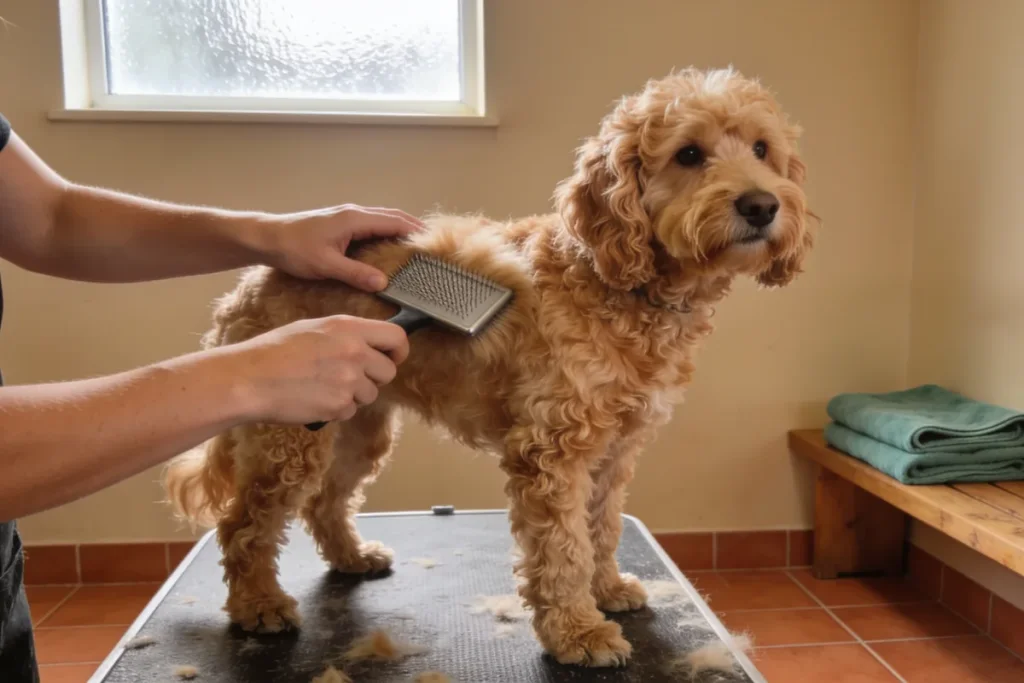
The salon door has a little bell on it, and the bell is the first thing the dog hates. He is a curly, apricot-coloured cross, eight months old, adopted in autumn, and he has never been anywhere that smells like this: shampoo, warm air, other dogs. He plants his feet on the mat. His owner stands there holding the lead, a little embarrassed, wondering whether to go in or go home, and whether the person behind the counter will be gentle with him once the door closes. That last question matters most. A good groom matters, but the groomer worth going back to is the one your dog walks out from calm, and you can find out a great deal about that before the first full clip.
Start with the coat
Everything a groomer does follows from the coat in front of them, so it helps to know what yours is before you ring anyone.
Some dogs barely shed. The RSPCA names Poodles, Maltese Terriers and Schnauzers among the breeds that do not shed and need clipping instead. The clipping keeps the coat manageable, and in hot weather it also helps prevent heat stress. The RSPCA is also frank that clipping is a skill. It generally advises using a trusted professional groomer, and notes that your vet can recommend one. If your dog is a curly-coated cross, you are probably in this group.
Other dogs carry a double coat: a dense undercoat beneath longer guard hairs. The chief veterinary officer of the American Kennel Club, a US body, explains that this kind of coat insulates the dog. Shaving it can raise the risk of heatstroke rather than lower it, and it can spoil the way the coat grows back. So if a groomer suggests shaving a double-coated dog right down, it is fair to ask why, and to listen to the answer. There may be a good reason, such as a coat too matted to save, and a good groomer will be able to explain it.
Then there are the long, heavy coats that mat if you look at them sideways. These are the dogs whose grooming bill changes most from visit to visit, and we will come back to why.
When you ring a groomer, start by describing the coat. Then listen to the questions they ask back. Someone who wants to know the breed or cross, the coat length, how often the dog is brushed at home and when it was last groomed is already doing the job properly.
It is also worth asking how often they groom coats like your dog’s. A groomer who mostly works with short-coated breeds may be perfectly capable, but the one who clips curly crosses every day will have seen your dog’s coat at its worst and knows what it can become.
The meet-and-greet and a short first visit
The apricot cross does not have to have his full groom on day one, and neither does yours.
Ask whether you can book a short first appointment: a bath and tidy, or nails only. It is a smaller ask of a nervous dog, and it gives you a look at the salon before you commit to a long session. If the short visit goes badly, you have lost very little. If it goes well, the dog’s second visit starts from a place he has already survived once.
While you are there, watch the greeting. Does the groomer let the dog come to them, or reach straight for the collar? How do they lift him onto the table? Is there a moment of talking to him, of letting him sniff a brush before it goes near his back? None of this takes long, and you can see it with your own eyes.
A salon with a visible grooming area is a good sign. One owner described a place where you could see the groomers working behind a window, and the dogs on the tables always looked relaxed. You cannot ask for a better reference than that. If the work area is out of sight, ask whether you can watch for a few minutes, or wait nearby for the first visit. How the groomer responds to that request is worth noting in itself.
For the apricot cross, the meet-and-greet went like this. The groomer came round the counter, crouched a metre away and did nothing at all for half a minute. The dog stopped pulling. He took one step, then another, and sniffed her sleeve. Only then did she touch him, under the chin rather than over the head. It took perhaps two minutes, and his owner learned more in those two minutes than from any review.
Handling and restraint
This is the part that keeps owners of anxious dogs up at night, and with reason. Some owners describe groomers who handled their dog heavily. Others found one who would go at the dog’s pace, and talk about that groomer the way people talk about a good GP.
There is no licence to check for dog groomers, so the questions do the vetting. Ask these before you book:
- How do you handle a dog who panics on the table?
- If my dog is too stressed to finish, will you stop and rebook rather than push through?
- Do you use muzzles, and if so, when and for how long?
- Will you call me if my dog is distressed?
- Have you worked with anxious or newly adopted dogs before?
The phrases to listen for are the ones nervous-dog owners use themselves: “force free”, “at your dog’s pace”, groomers who say they specialise in anxious dogs. A groomer who answers question two with a clear yes, and who sounds as though they mean it, has told you most of what you need to know. One who tells you every dog settles eventually has told you something too.
Drying, heat and time in the crate
Back at the salon, the bath is over. The apricot cross is damp and shivering a little, and now comes the part his owner was warned about: the dryer.
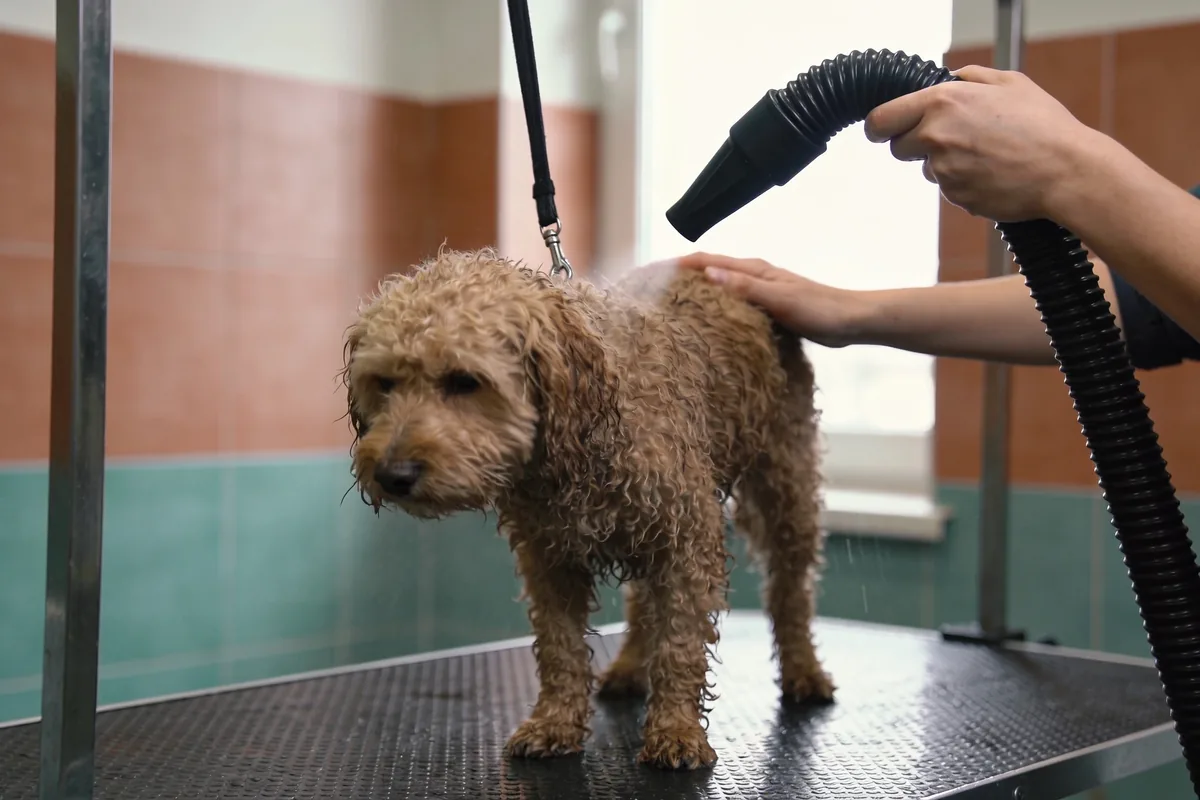
For plenty of dogs, drying is the hardest part of the visit. One owner hunting for a patient groomer put it simply: her dog was frightened of the blow dryer, especially around his face. There are two broad approaches. Hand-drying means the groomer works over the dog with a handheld dryer, usually on the table, adjusting the airflow and keeping it away from the eyes and ears. Cage or crate dryers blow warm air into an enclosure while the dog waits inside.
Ask which the salon uses. If it uses heated cage dryers, ask how the dogs inside them are monitored, and how often someone checks on them. The RSPCA’s guidance on heat stress makes the general point that some dogs cope with heat less well than others. Flat-faced breeds, older dogs, overweight dogs and anxious dogs are the ones to ask about specifically. If your dog is one of them, say so when you book, and ask what the groomer does differently.
Ask, too, how long your dog will be there. A groom can take a while, but a long stretch in a crate waiting for collection is a different thing. Some salons will ring you when the dog is finished so that you can collect promptly. For a nervous dog, that phone call can be worth more than any extra on the menu.
Matting, and why the price changes
If the price on the website says “from”, there is a reason.
A groom is priced on the size of the dog, the condition of the coat and the dog’s behaviour on the day. The condition of the coat is the one that moves most. A matted coat takes far longer to work through, and it is not always kind to try. The RSPCA notes that clipping removes mats if they occur. A groomer faced with a badly matted dog may recommend a shave-down instead of hours of de-matting, as a welfare decision rather than a short cut. It is reasonable to ask which they would recommend for your dog and why.
Behaviour is the third part of the price, and the one owners of nervous dogs should be glad to see. A dog who needs breaks, who has to be coaxed back onto the table, or who can only cope with the dryer in short bursts, takes longer to groom. A groomer who prices that time honestly is telling you they intend to take it, rather than hurry him through.
Before you book, ask what the price includes. The usual list is:
- bath and dry
- the clip or style
- nails
- ears
- anal glands, which some groomers leave to vets, so ask
A price that covers all of these is a different offer from one that covers the bath and clip alone, even when the headline number looks the same.
How often to book
There is no single answer here, and you can be suspicious of anyone who gives you one without asking about the dog. The RSPCA says that how often a dog needs bathing depends on its coat, its skin, its health and how active it is, and that your vet can advise. Grooming frequency follows the same logic. A clipped curly coat will need regular visits to stay comfortable. A short coat may need very little.
What you do between visits matters as much as the visits themselves. Brushing at home, a few minutes at a time, keeps mats from forming. That makes the next groom shorter and gentler, and it gets your dog used to being handled, which helps the groomer too.
If you are not sure where to start, ask your groomer at pick-up. Many will happily show you which brush or comb suits the coat, and where the mats tend to start on your particular dog. Five minutes of that lesson can save a shave-down later.
Mobile groomers come to your house and work in a van, which can suit a dog who finds the salon itself the problem. A salon has more space and equipment, and sometimes more staff to help with a difficult dog. Neither is better in every case, so ask the same handling questions of both.
When it is a vet job
Groomers see parts of a dog that owners often miss. A good one will mention a lump, a patch of irritated skin, sore ears or anything else that looks wrong, and that is your cue to see the vet, not to ask the groomer for a diagnosis.
Some dogs find grooming so stressful that sedation becomes part of the conversation. That is a vet’s decision, arranged through the vet, and the vet can also advise on whether grooming should wait. If you are still looking for a vet you trust, this site’s guide to choosing a vet covers what to look for.
Calm in, calm out
The apricot cross went back three weeks later. His owner booked a nails-and-tidy session first, watched the groomer through the window, and asked about the dryer before anything else. On the third visit he walked through the door without planting his feet.
That is what you are looking for. Start with the coat and find a groomer who asks about it. Book a short first visit and watch how your dog is greeted and lifted. Ask the handling questions, especially whether they will stop and rebook. Find out how the dog is dried and how long he will wait. Then ask exactly what the price covers. There is no licence to check, so your questions and your dog’s face at pick-up are the best measures you have.
Sources: RSPCA Knowledgebase, Why and how should I groom my dog? (https://kb.rspca.org.au/knowledge-base/why-and-how-should-i-groom-my-dog/); American Kennel Club, Is it OK to shave your dog? (https://www.akc.org/expert-advice/health/is-it-ok-to-shave-your-dog/)