
Septic Tank Pump-Out Has No National Interval, and the Docket Is Your Proof
 Pratiksha Rimal

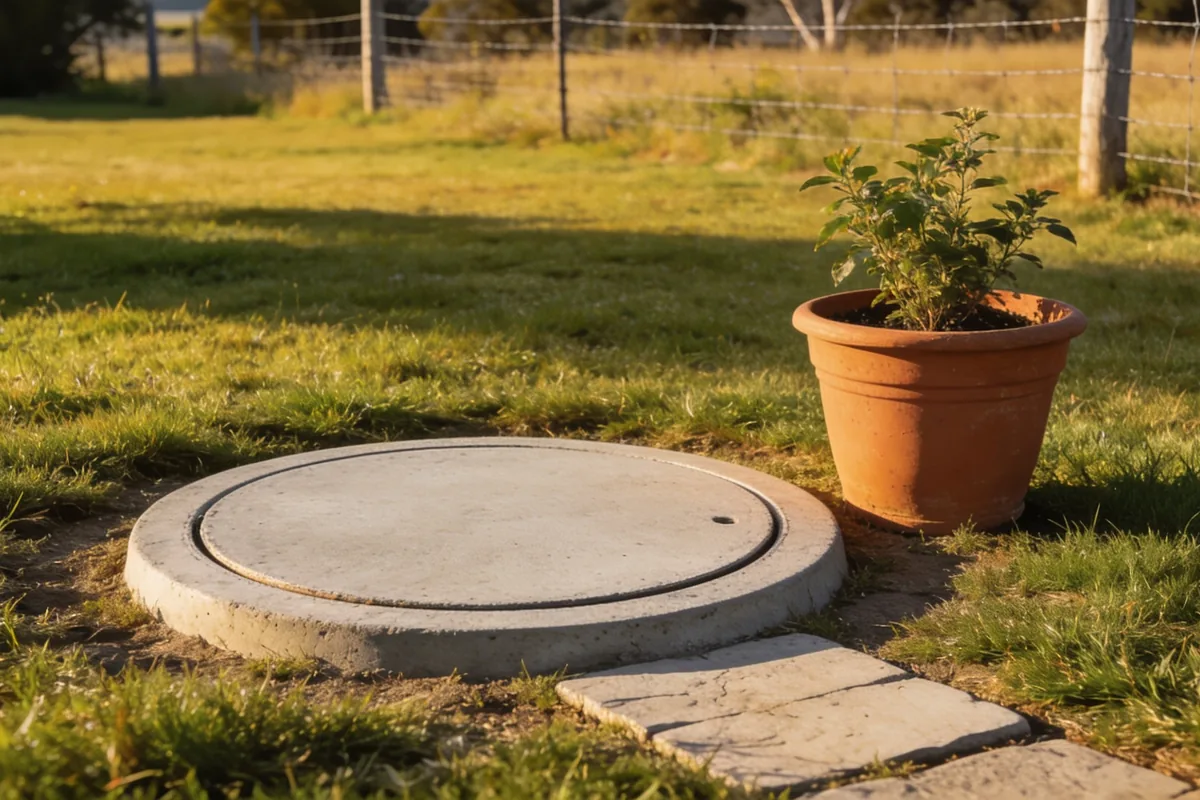
Picture a lifestyle block in mid-October. The grass has had its spring growth spurt, the gums along the fence are dropping bark, and somewhere in the lawn there is a round lid that nobody has thought about in years. Then the relatives start talking about staying over the holidays, and suddenly the lid matters. When was that tank last pumped out? When is it due? And where, if anywhere, is the paperwork?
This guide answers those three questions from what government and council pages say. The short version is that three to five years is a guide, not a rule. Your interval is whatever your council approval, your state’s health rule or the manufacturer sets. A licensed agent’s check of the sludge decides it on the day. And the pump-out docket is how you show it was kept. This is general information, and your own council and approval letter decide what applies to you.
Three to five years is a guide, not a rule
Three to five years is the figure several council pages give, with a shorter gap for bigger households. It is a fair rule of thumb. The trouble is that it describes an average, and your tank is not an average.
The official pages read quite differently from one another. One Victorian council says to pump out at three-year intervals unless the licensed plumber advises otherwise. EPA Victoria gives no figure at all. WA Health says every four years, or more often if the installation approval says so. The Northern Territory Government says a well-maintained tank needs desludging once every three to seven years. One Queensland council and two New South Wales councils say three to five.
None of the pages we read points to a national rule. Each state, council or approval sets its own. That is an observation from twelve pages, not a search of every instrument, so take it as a strong pointer and not a legal opinion.
What each state and council page says
The table lines up what each page says about timing. Where a page carries no date of its own it is marked undated, and it is reported as what that council’s page says, not as a dated rule.
What the pages say about pump-out timing
| Jurisdiction | What the page says about timing | Source |
|---|---|---|
| Victoria, state | No fixed interval. It depends on how much the system is used and the manufacturer’s requirements | EPA Victoria, updated 22 May 2025 |
| Victoria, council | Every three years unless the licensed plumber advises otherwise | South Gippsland Shire Council (undated) |
| WA, state | Every four years, or more often as the approval conditions say | WA Department of Health, last reviewed 10 Oct 2025 |
| WA, public guide | As a guide, every eight years for two people and every four years for four people, more often for larger households | HealthyWA (undated) |
| Queensland, council | A licensed service agent every three to five years to check for excess sludge, plus a visual check every 12 months | City of Moreton Bay (undated) |
| Queensland, council | De-sludge regularly, with no figure given | Logan City Council (undated) |
| NSW, council | Every three to five years, depending on usage | MidCoast Council (undated) |
| NSW, council | Generally every three to five years, varying with usage and conditions | Camden Council (undated) |
| NSW, council | No interval given. The owner is responsible for operation and maintenance | Byron Shire Council (undated) |
| SA, council | The council requires every four years, which it says is in line with Department of Health requirements | Kangaroo Island Council (undated) |
| SA, council | Tanks on the council scheme are pumped by a council contractor every three years | Regional Council of Goyder (undated) |
| NT, government | Three to seven years for a well-maintained tank | NT Government (undated) |
Two cautions. The South Australian entries are two councils’ pages: Kangaroo Island says its four years is in line with Department of Health requirements, and we did not find a statewide South Australian page. And Tasmania and the ACT are not covered here. If you live in either, ask your own council what applies, because we are not making a claim for them.
When you need someone to ask, the Plumber category in our directory is a place to start looking for a local licensed plumber, though a listing is not a licence check.
Why the figures differ
Much of the spread comes from the household and the tank. Household size is one factor. The public WA guide puts a two-person household at eight years and a four-person household at four, more often for larger ones. Tank size is another. MidCoast Council says the timing depends on tank capacity, and the Northern Territory page sets tank size against daily flow. That page also lists what shortens the gap: personal care products, fats, oils and grease, harsh chemicals, disinfectants and bleach, antibiotics and flushed plastics.
Then there are the paper factors. WA Health points to the installation approval conditions, and says to contact the council’s Environmental Health Officer for further information. EPA Victoria points to the manufacturer’s requirements. These can beat any average, because they are written for your system.
There is a fair point on the shorter-interval side, too. A big household, or one that sends a lot of fats, oils and bleach down the drain, can make a shorter gap the right one. That is why a licensed agent’s sludge check is the proper tie-break. A calendar cannot see inside your tank.
A hypothetical, with dates only. Say a standard tank was pumped in October 2026. Under the Victorian council’s guide, the next pump-out would fall around October 2029. Under Kangaroo Island Council’s requirement, it would fall in October 2030. Under the Northern Territory’s three to seven years, it could fall anywhere from October 2029 to October 2033, depending on use. Same tank, three different due dates, and none of them is wrong in its own place.
Pumping out, servicing and the filter are different jobs
These three jobs are easy to blur. The pages we read keep them apart.
A pump-out removes sludge and scum so the settling tank can work. A service is a separate thing. The South Gippsland council’s page says a pump-out is not a service, and that it should not be the first response to poor performance. When a council authorises a system, ongoing servicing requirements attach to it.
Servicing cycles belong mainly to aerated systems. Logan City Council says an aerobic treatment plant is serviced every three months and an aerobic sand filter every year, and that the owner keeps a copy of the service report. Camden Council says an aerated system must be serviced quarterly by a qualified agent, in line with NSW Health accreditation. Those cycles are for aerated treatment units, not standard septic tanks.
Then there is the outlet filter. The City of Moreton Bay page says to clean it in line with the manufacturer’s instructions, and gives no frequency.
So, does a tank need a pump-out if nothing smells? The pages we read tie the answer to the approval conditions and to a sludge check by a licensed agent, not to what you can smell. The Moreton Bay page pairs that check with a visual look once every 12 months.
Who may pump the tank, and where the waste goes
The pages name who may do the work, and the wording varies by place. EPA Victoria says professionals such as a licensed plumber or an accredited servicing agent can desludge. WA Health says a licensed contractor must pump the tank out. Moreton Bay refers owners to an appropriately licensed service agent and points to the Queensland Building and Construction Commission’s search. MidCoast Council says an approved liquid waste transporter empties pump-out tanks. The Northern Territory page says to always use a licensed waste handler.
The same habit of checking a trade’s licence runs through our guide to vetting a pest controller. It applies here too.
Where the waste goes matters as much as who takes it. EPA Victoria says septic tank waste is priority waste, and an owner must take all reasonable steps to make sure it goes to a place authorised to receive it. Kangaroo Island Council says its contractors must advise the council when a tank is desludged, and the council keeps a database.
One practical point comes from the Regional Council of Goyder. If the contractor cannot reach the hatch, the owner arranges their own pump-out. So the lid and the ground around it need to be clear on the day.
The Utilities category in our directory is another place to begin a search. Confirm the licence yourself, whichever listing you start from.
What the docket should record
Here the sources are thin. No page we read prescribes a docket format, so the checklist below is ours, not a legal form. But several pages do set a record duty, and a good docket covers them.
- The date.
- The property, and which tank or chambers were pumped.
- The volume removed, in litres.
- The contractor’s name, and the licence or approval type your state uses.
- Where the waste was taken, named as an authorised facility.
- The operator’s note on sludge and scum depth, and on the condition of the lids, baffles and outlet filter.
- That the tank was refilled with water and not washed out or disinfected.
- The next recommended date, and the reason for it.
Which lines meet a duty? EPA Victoria says the owner must keep maintenance records and give them to council on request. The Northern Territory page says to keep a record of your pump-outs, and adds that after desludging you should not wash out or disinfect the tank, and should refill it with water, because a small residue of sludge must stay. Logan City Council says to keep the service report. The authorised-place line follows Victoria’s reasonable-steps duty, and Kangaroo Island contractors must report the desludge to council. The rest of the list is our suggestion, and it makes the paper easier to use.
Questions to ask before you book
You do not need a script. A few plain questions do most of the work.
Ask your council for your approval conditions. WA Health says to contact the council’s Environmental Health Officer for further information, and MidCoast Council says each septic system needs an approval to operate. Ask the contractor what interval they recommend, and why. Ask for the sludge reading. Ask where the waste goes. And ask for the docket to be itemised, so it covers the lines above.
File the docket with the approval letter
Keep the docket with the approval letter, the manufacturer’s manual and any service reports, in one folder you can find in a hurry.
The next time the lid comes up in conversation, you will know the date, the reason and where the paper is.
Sources: Manage an onsite wastewater management system, EPA Victoria (https://www.epa.vic.gov.au/manage-onsite-wastewater-management-system); Servicing wastewater systems, WA Department of Health (https://www.health.wa.gov.au/Articles/S_T/Servicing-wastewater-systems); Understanding septic tank systems, HealthyWA (https://www.healthywa.wa.gov.au/Articles/U_Z/Understanding-septic-tank-systems); Check and pump out your septic tank, NT Government (https://nt.gov.au/property/homeowners-and-landlords/maintain-and-improve-your-home/septic-tank-systems/check-and-pump-out-your-septic-tank); Maintain your septic system, South Gippsland Shire Council (https://www.southgippsland.vic.gov.au/info/20063/septic_tanks/397/maintain_your_septic_system/5); On-site sewerage facilities, City of Moreton Bay (https://www.moretonbay.qld.gov.au/Services/Building-Development/Plumbing/On-site-Sewerage-Facilities-OSFs); On-site sewerage facilities, Logan City Council (https://www.logan.qld.gov.au/planning-and-building/plumbing-and-drainage/on-site-sewerage-facilities); On-site wastewater management, MidCoast Council (https://www.midcoast.nsw.gov.au/Development/Planning-framework/On-site-wastewater-management); Onsite sewage management, Camden Council (https://www.camden.nsw.gov.au/environment-and-regulatory-services/onsite-sewage-management); On-site sewage management, Byron Shire Council (https://www.byron.nsw.gov.au/Development-Business/Building-Construction/Plumbing-Sewage/On-site-sewage-management); Septic tanks, Kangaroo Island Council (https://www.kangarooisland.sa.gov.au/services/water-and-wastewater/septic); Waste water management (CWMS), Regional Council of Goyder (https://www.goyder.sa.gov.au/services/waste-water-management-cwms)