
How to Choose a Pest Control Company: What a Treatment Should Actually Include
The question under the question
The pest control decision is difficult for a reason that has little to do with pests. Most readers approach it in the wrong order. They collect three quotes, compare the totals and choose the middle one, before they have established what each price is actually buying.
A general pest treatment is not one job. It can be a surface barrier spray around the outside of the house, a targeted bait program aimed at one pest, or a full internal and external treatment that takes in the roof void and the subfloor. Those are three different jobs at three different prices, and a flat annual quote will not tell you which one is on offer. The useful first step is to define the problem, not to gather prices.
This article is general information about choosing a pest control company, not a recommendation of any one operator. Licensing and chemical-use rules differ between states and territories, so treat the checks below as the starting point and confirm current requirements with your state or territory pest management licensing authority before you book.
Know what you are treating, and what you are not
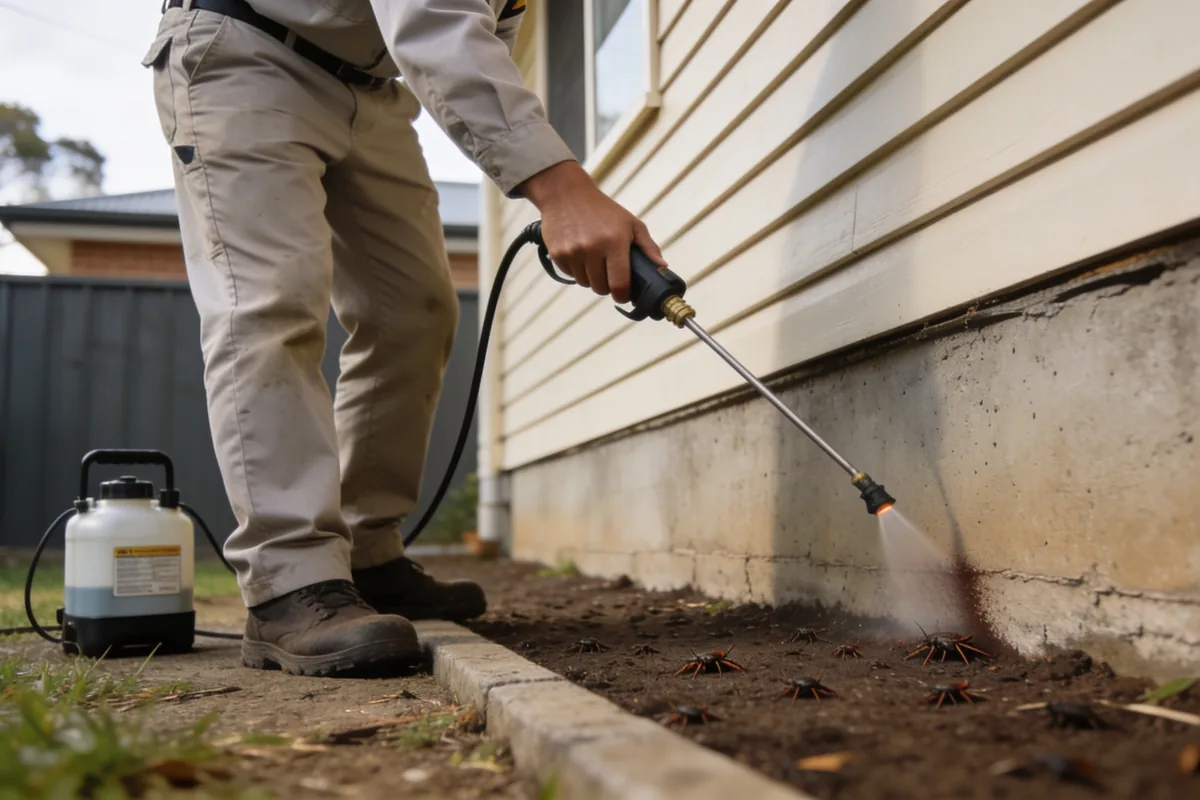
Most household pest problems fall into four groups, and each responds to a different kind of work. Cockroaches and ants are the everyday pests: frequent, manageable, and usually best handled with a targeted bait or gel program rather than a blanket spray. Spiders are kept down with barrier treatments around the outside and web removal, which is why a technician spends time on the exterior rather than inside. Rodents are a different skill again, because baiting alone does not solve a mouse or rat problem unless the points of entry are found and proofed.
Termites sit apart from all of these. Termite work is a separate, higher-stakes service that usually needs a different licence class and a timber pest inspection, not a general spray. A general treatment is not a termite treatment, and no honest operator will pretend otherwise.
Knowing when to call a professional is part of the same question. For a small, contained problem, many readers reasonably try a targeted bait from a hardware store first, and that is a legitimate place to start. The professional earns the fee when the problem is established or spread through a house, when the source is not obvious, or when the pest is a termite. An honest operator will not invent a reason why a single ant trail needs a whole-house barrier program.
The other part worth understanding is that treating the symptom without the source is how repeat callouts happen. Spray the ants that are visible and the nest keeps producing them. Remove the nest, or the food source, and the problem settles. The operator who only ever wants to spray is asking to come back; the operator who wants to find out why the pests are there is doing the job properly.
What a treatment actually includes
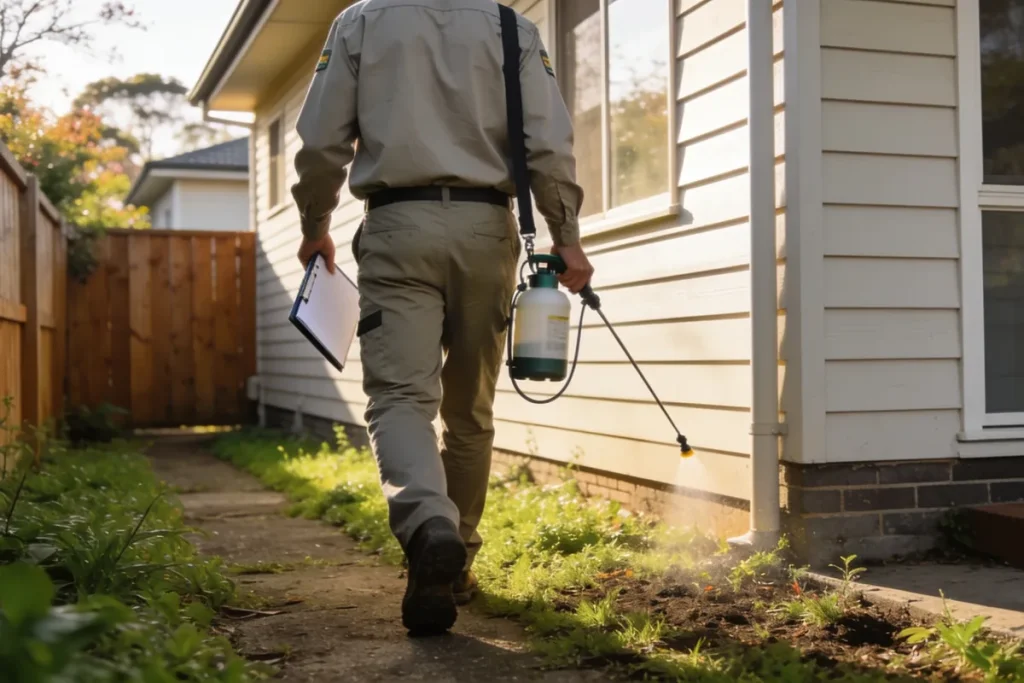
A genuine treatment visit is a piece of work, not a person with a sprayer walking the fence line. A careful technician inspects before treating, and the visit should normally include the inspection, the products applied, and a plain explanation of what was found. Because practices differ between operators and states, the point is not that every visit looks identical. The point is that the reader should be told in writing, before the visit, what it will cover.
| What a genuine visit includes | What a vague or cut-price visit skips |
|---|---|
| An inspection of the likely entry points and harbourage areas before anything is sprayed | A surface spray with no inspection behind it |
| The specific products used, and where they are applied: inside skirting and kitchen voids, outside the perimeter, and the roof void and subfloor where relevant | A flat general pest treatment with no detail on what goes where |
| Clear instructions for before and after: clear the area, keep pets and children away until dry, and leave webs and droppings for the technician to assess | A visit that ends without the householder being told what to do |
| A note of what was found and what was treated | A visit that finishes with no explanation of the result |
If a quote cannot say what the visit will include, that is the first thing to ask about, before the price. The operator who cannot say whether they will inspect the roof void or treat inside the kitchen voids is not necessarily dishonest. They may simply run a thinner service, and the reader deserves to know which one they are buying.
A written scope is the most useful single document a reader can ask for. It does not need to be long. It needs to name the pests, the method, the areas and the follow-up, and a paragraph of plain English is enough. A company that sends one without being asked is showing how it works. A company that treats the request as a burden is showing that too.
The licence, the insurance and the industry mark
In Australia, pest management technicians work under state and territory licensing. The rules govern chemical use, and termite and timber pest work carries its own requirements that vary by state. The products they use are registered by the Australian Pesticides and Veterinary Medicines Authority, the APVMA. Licensing is not one national law, which is exactly why the check belongs in the vetting.
- The licence class should match the job. A licence for general spraying is not necessarily the licence for a timber pest inspection, so ask to see the class that covers the work being quoted.
- Public liability insurance should be current. A reputable operator holds it and does not mind being asked about it.
- Industry membership is a softer signal but a useful one. Technicians who follow the standards of a body such as the Australian Pest Control Association are generally easier to hold to a professional standard.
These checks take minutes, and they separate a genuine operator from an overseller more cleanly than any price comparison. A licensed, insured technician expects the questions. The operator who is vague about their licence is answering them.
Reading the quote: what a fair one itemises
A quote is a document, and a fair one names its parts. When a quote itemises the job, the reader can compare it honestly against the next one. When it does not, there is nothing to compare.
| A fair quote names | Red flags to treat seriously |
|---|---|
| The pests targeted | A single lump-sum annual price with no scope attached |
| The treatment method: spray, bait, or both | The phrase you will not need to see the detail |
| The areas covered: internal, external, roof void, subfloor | Pressure to sign an ongoing contract on the first call |
| Whether a termite inspection is included or extra | A price well below the others with no explanation |
| The number of visits in the price | Hesitation when asked to put the guarantee in writing |
| The guarantee, and what it covers | No written scope at all |
An annual program can be the right call for some homes. Properties under high pest pressure and older homes on stumps often benefit from a regular visit, and a program can be cheaper than paying for separate callouts each time a pest reappears. The honest position is that the reader should know what each visit includes before committing to a year of them, and should be free to pause the program if the visits stop earning their keep.
Termites are the separate conversation
Termites deserve their own paragraph because they are the high-stakes end of the category, and the stakes are handled best with facts rather than fear. Termites are present across most of Australia, and the defence against them is inspection, not luck. A pre-purchase or annual timber pest inspection is a different service from a general treatment, and it is normally carried out to a recognised standard by a licensed inspector.
A reader who suspects termite activity should have it assessed promptly. The honest reason is simple: the longer termite activity goes on, the more it costs to fix, and an early finding turns an expensive repair into a manageable one. No article can put a figure on that damage, because every situation differs, and any number that claims otherwise should be treated with suspicion.
The practical instruction is to verify the inspector as well as the inspection. Confirm that the person doing the timber pest work holds the relevant state licence for it, and ask what the inspection covers and what it does not. A timber pest inspection is a snapshot of a building at a point in time, and an honest inspector will say so rather than promise a guarantee against a pest that can arrive after the report is written.
The guarantee and the follow-up
A guarantee is only useful if the reader understands what it covers. In pest control, a guarantee normally promises a defined re-treatment period for the pests named in the scope, and it usually carries conditions. The reader may be asked not to disturb the treated areas, to keep the property in a state that does not invite the pest back, or to report a problem within a set window. None of those conditions is unreasonable, but all of them should be in writing before the first visit.
The follow-up matters just as much as the original treatment. Ask how a re-treatment is booked, whether it costs anything, and who the reader calls if the pests return between scheduled visits. A company with a real follow-up process will answer those questions without a pause. When a company hesitates to put its guarantee in writing, the reader has already learned what they needed to know.
The explanation is part of the treatment
The product the reader is paying for is not the spray. It is the assessment, the written scope and the follow-up that turn a chemical application into pest control. The operator who explains what they found and what they did is the one to rebook. The operator who will not itemise the job is the one to keep shopping past, whatever the price says.
The decision rule is a short one, and it holds across every state and territory. Define the problem before you compare prices. Check that the licence class matches the job. Get the scope and the guarantee in writing. And treat a termite suspicion as its own separate conversation, with its own licensed inspector, rather than folding it into a general spray.
This remains general information rather than advice on any single company. The operator who is happy to be checked against their state licensing authority, their insurance and their industry body is the one who is unlikely to mind the reader asking.
Sources: Australian Pesticides and Veterinary Medicines Authority (APVMA), registered products · your state or territory pest management licensing authority · Australian Pest Control Association, consumer advice on choosing a pest controller