
Gutter Cleaning Before Storm Season: What the Crew Should Do Up There

The first storm of the season came in on a Thursday evening, and you could smell it before you heard it. By eight o’clock the rain was loud on the roof, and Meg was at the kitchen sink when she saw water falling past the back door. It came over the lip of the gutter in a single grey sheet, hit the back step, and spread across the paving towards the laundry. The downpipe on that corner, the one that should have been carrying all of it, was barely dribbling.
She had paid for a gutter clean the spring before. She remembered the whine of a blower, a man on a ladder, and a drift of brown leaves across the garden bed by the side fence when he left. What she could not remember was anyone checking where the water went once it reached the gutter.
That is the part most of us never see, and it is the part that decides whether the money was well spent. A gutter can look tidy from the lawn and still fail in the first downpour, because gutter cleaning is judged at the bottom of the downpipe, where the water either runs clear or backs up. If you are the homeowner who has decided not to climb onto a two-storey roof, and that is a sensible decision, the useful thing to know is what the crew should be doing while they are up there.
Why now: storms first, then fire season
Late spring is when the two halves of the Australian summer start arguing over your gutters.
The storms come first. A gutter packed with leaves, seed pods and grit holds water instead of moving it, and when it fills it overflows wherever it can. Sometimes that is over the front edge, onto a path or a step, which is unpleasant but visible. Sometimes it is over the back edge, into the eaves, behind the fascia and down the inside of a wall, which is where the expensive damage starts and where nobody notices it until a stain appears on a ceiling.
Then fire season arrives, and the same leaves become fuel. Dry leaf litter sitting in a gutter is exactly the kind of fine material an ember can land in and light. The NSW Rural Fire Service and the CFA in Victoria both put clearing gutters of leaves and twigs near the top of their lists when they describe how to prepare a property. It is one of the first jobs they name.
Both services also talk about the trees above the house. The RFS advises cutting back branches that overhang the roof, which also means less material landing in the gutters for the rest of the year. A small branch is a job for the crew or a pair of loppers. A large tree is a different matter, and in many council areas you may need a permit before anyone takes a saw to it. This site’s guide to hiring an arborist and checking whether you need a tree permit walks through that side of it.
What the crew should do up there
Picture the crew arriving at Meg’s house this year. Two of them, a ladder each, a vacuum unit on the trailer and a stack of empty bags. That stack of bags tells you something before anyone has climbed.
The debris should come out by hand, with a scoop, or through a gutter vacuum, and go into bags. Blowing it off the roof is quicker, but it moves the problem rather than removing it. The leaves land in your garden beds, on the path, in the pool or over the fence into the neighbour’s yard, and some of it blows straight back into the gutter on the next windy afternoon. Wet, rotting debris left in heaps around the house is also an open invitation to insects and other pests, which is one more reason to ask where it is going. If you already have a problem with pests sheltering around the house, this site’s guide to vetting a pest control company is worth a look.
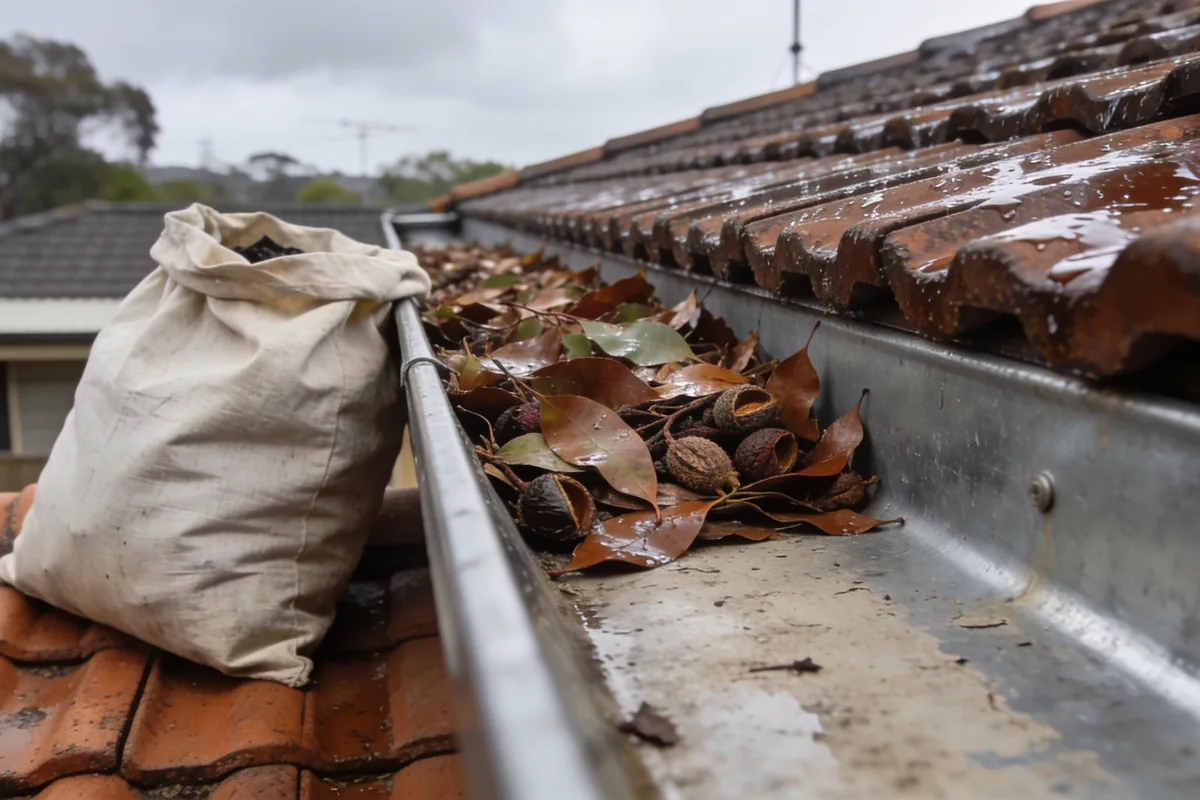
Once the gutters are empty, the job is only half done. Every downpipe should be flushed with a hose from the top, and someone should be at the bottom watching the water come out. A blocked downpipe is the most common reason a clean gutter still overflows: the leaves that were sitting in the gutter have been pushed down into the pipe, where they settle at the first bend. If the water does not run freely at ground level, the crew should clear the pipe before they pack up.
Then there are the awkward places. Box gutters, the flat channels that run between roof sections or behind parapets, hold water and debris in a way an eaves gutter does not, and they overflow inside the house rather than outside it. Valleys, where two roof slopes meet, collect leaves that slide down from both sides. A crew that cleans the eaves gutters and ignores the box gutter and the valleys has left the most important parts of your roof untouched.
Last, the crew should tell you what they found. A loose bracket, a section of rusted gutter, a cracked tile or a dislodged ridge cap are all things a person on the roof can see and you cannot. What you want is a photo and a conversation before anything is touched, so you decide what gets fixed and the next storm does not find it first.
Before and after: what to ask for
When you book, ask for three things in writing.
First, photos of each gutter run before and after. A run is one continuous length between corners or downpipes, so a simple single-storey house might have four and a larger home a dozen. Photos let you see what was there and what is left without climbing a ladder yourself, and they make any damage report concrete.
Second, confirmation that every downpipe was flushed and ran clear at the bottom. A crew that does this properly will be happy to say so, and some will send a short video.
Third, a clear answer on where the debris goes. Bagged and taken away is the standard to ask for. If you are combining the gutter clean with a bigger tidy-up, such as cutting back the garden or clearing a shed, the volume can surprise you, and this site’s guide to skip bin hire explains how to size a bin for that kind of clean-up.
Working at height: the insurance questions
Meg asked a question on the phone that she would never have thought to ask the year before: what happens if one of your people falls off my roof?
It is a fair question, and a good company will not be offended by it. Ask for proof of public liability insurance, preferably a certificate of currency, which shows the policy is current. Then ask who covers the crew themselves if someone is injured on your property, because public liability is generally about damage to you and your property, and injury to the workers is usually a separate cover. A business with employees should have its own cover for them, and it is reasonable to hear that in plain words.
Ask, too, how they work on steep or two-storey roofs. A harness, roof anchors or edge protection are the kinds of answers you want to hear. One homeowner who asked online about doing her own second-storey gutters was told by a tradie, quite firmly, that he would wear a harness and have a rescue plan before trying it, and that he would rather she did not. Another reply in the same thread made the case more bluntly: paying a crew was cheaper than living with the injury. Both were making the same point: height is the dangerous part of this job, so it is the part to ask a company about most carefully.
How often
There is no honest single answer to this, and a company that gives you one without asking about your trees is guessing.
The deciding factor is what grows above and around the roof. A house under a tall eucalypt sheds bark, leaves and gumnuts most of the year, and gutters there can fill quickly. Pines drop needles that knit together into a mat. A house in an open suburb with young street trees and nothing overhanging might go a long time between cleans without trouble.
Season matters as well. The clean before storm season and fire season does the most work, and a big storm can change the picture overnight by dumping a load of leaves at once. A useful habit is to walk around the house during heavy rain, the way Meg did by accident, and watch the gutters and the downpipes. Water spilling over the edge, or a downpipe that stays quiet while the roof is pouring, tells you more than any calendar.
Gutter guards are a separate decision
Some crews will suggest gutter guards while they are up there, and they can be worth considering, but that is a different purchase with its own questions. Guards reduce what gets in. They do not remove the need to check the gutters and flush the downpipes, because fine material still gets through and leaves still pile up on top. This guide stays with the cleaning. If the subject comes up, treat it as a separate quote to think about later, and do not let it replace the clean you booked.
Judge it at the downpipe
This year Meg stood in the drizzle at the bottom of the back corner while one of the crew ran a hose into the gutter above. For a second nothing happened. Then the downpipe coughed, a clot of black leaves dropped into the grate, and a clear, steady stream followed it. That was the moment she knew the job had been done.
When you book your gutter cleaning, ask for debris bagged and taken away, every downpipe flushed and confirmed at the bottom, box gutters and valleys included, damage reported with photos, and proof of insurance. Ask how they work at height. Then, when the first storm arrives, go and look at the downpipes. They will tell you whether the job was done properly.
Sources: Prepare your property, NSW Rural Fire Service (https://www.rfs.nsw.gov.au/plan-and-prepare/prepare-your-property); How to prepare your property, CFA Victoria (http://www.cfa.vic.gov.au/plan-prepare/how-to-prepare-your-property)