
Pre-Purchase Car Inspection: Who Should Do It, and What the Report Must Cover
The car has been found, the test drive went well, and the seller has asked for a deposit to hold it. This is the point at which most used-car mistakes are made, because the buyer has decided emotionally and the remaining checks feel like formalities. A pre purchase car inspection is the one check that can still change the decision, but its value depends almost entirely on who carries it out and what the written report contains. An inspection that consists of a walk around the car and a verbal “looks fine” gives the buyer very little. The checklist below sets out what a buyer should have in hand before paying, and the sections after it explain each item.
Before you pay for a used car
0 of 10 checkedTick these off between the test drive and the deposit.
Three kinds of inspector
Buyers generally choose between three options: a mobile pre-purchase inspector who comes to the car, an inspection service run by a motoring club, or the buyer’s own mechanic in a workshop. They differ less in competence than in what each can physically see, and that difference should drive the choice.
| Inspector | Where it happens | What it can usually see | What it usually cannot | Access needed from the seller |
|---|---|---|---|---|
| Mobile pre-purchase inspector | At the seller’s home or yard | Exterior, interior, engine bay, a diagnostic scan, a road test if permitted | The underside in detail, without a hoist | Permission to inspect and drive the car where it is |
| Motoring club inspection | Mobile or at a nominated location, depending on the service | A structured checklist, often with a scan and road test | Depends on the service; ask whether a hoist is used | Permission to inspect, sometimes a booked time and place |
| Your own mechanic | The mechanic’s workshop | Everything above, plus the underside on a hoist | Little, if the car can be left for long enough | The seller’s agreement to bring the car to the workshop |
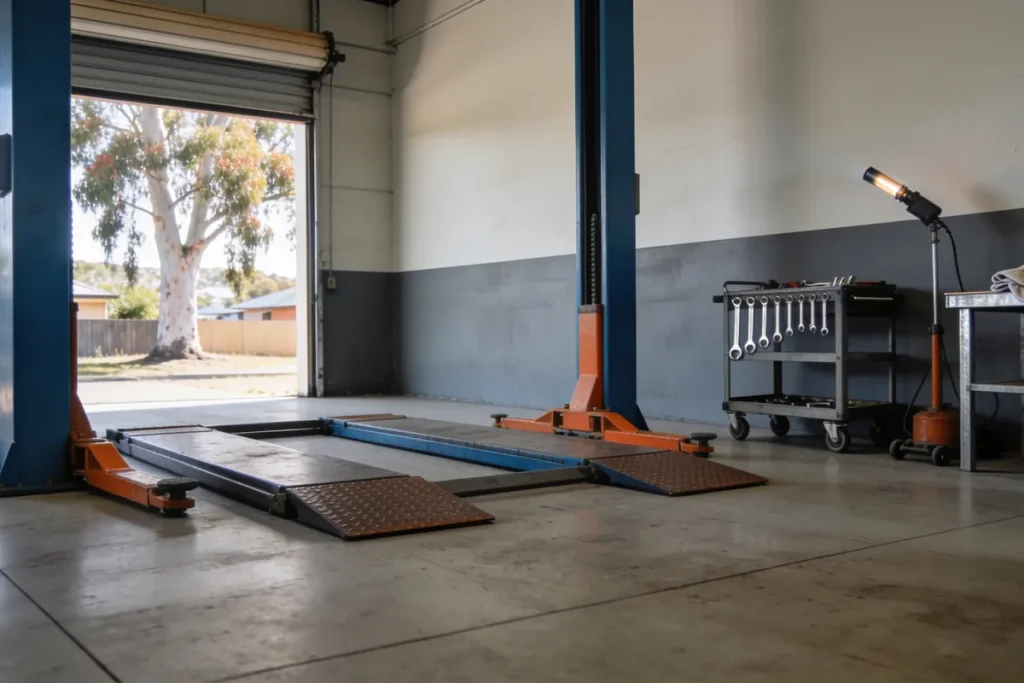
The hoist is the single largest variable. Oil leaks, damaged suspension components, exhaust condition, rust in the floor and chassis rails, and evidence of underbody repair are far easier to assess with the car in the air than from a creeper on a driveway. A mobile inspector working without one may still do a competent job, but the report should say what could not be checked as a result. The trade-offs between coming to the car and bringing the car in are set out in more detail in this site’s comparison of a mobile mechanic and a workshop.
Two further questions separate inspectors of any type. First, does the inspection include a road test, and will the inspector drive the car or only observe? Second, will the inspector start the engine from cold? A cold start reveals noises, smoke and starting faults that a warm engine can hide, which is why the car should not be driven before the inspector arrives. Buyers who have been disappointed by an inspection often describe the same shortfall: the inspector checked the exterior and little else. Asking these two questions at the booking stage avoids that outcome.
What the report must cover
The deliverable is the report, and it should be written, itemised and supported by photos. A verbal summary cannot be compared, relied on in a negotiation or checked later. At a minimum, the report should address:
- Body condition, including paint mismatch, panel gaps and other signs of accident repair.
- Rust, with its location and severity.
- Engine condition and fluid levels, and any leaks.
- The cold start: how the engine started and ran from cold.
- Transmission operation, manual or automatic.
- Brakes.
- Suspension and steering.
- Tyres, including tread and uneven wear.
- Electrics, and any warning lights on the dashboard.
- A diagnostic scan for stored fault codes.
- A road test.
- An estimate of urgent costs, listed separately from normal wear items.
- The inspector’s limitations: what was not checked, and why.
The last two items are the most often omitted and the most useful. Separating urgent repairs from routine wear tells the buyer which costs arrive immediately and which are simply the ordinary upkeep of an older car. A statement of limitations tells the buyer where the report’s assurance ends. A report that claims to have checked everything on a car inspected kerbside in the rain should be read with some caution.
The diagnostic scan deserves a specific note. It reads the fault codes stored in the car’s electronic systems, which can point to engine, transmission or sensor problems that produce no visible symptom on a short drive. A scan does not prove a car is sound, though it can surface problems that a visual inspection cannot, and the report should list any codes found rather than summarising them as “minor”.
What an inspection is not
Three distinctions are worth keeping clear.
An inspection is not a roadworthy or safety certificate. Those certificates are a separate, state-based requirement concerned with whether a vehicle meets minimum safety standards for registration or transfer, and they are not an assessment of overall condition or value. This site’s roadworthy certificate guide explains what a certificate covers and what it leaves out.
An inspection is also not a guarantee. It records the condition of the car on the day, as far as the inspector could see it. Faults can develop afterwards, and some cannot be detected without dismantling components.
Finally, an inspection is not a history check. An inspector can see signs of repair, but cannot see whether money is still owed on the car or whether it has been recorded as written off or stolen. That requires a separate search.
The PPSR is a separate step
The Personal Property Securities Register runs the official car search. According to the PPSR, a search shows whether a security interest is recorded against the vehicle, which typically indicates money owing and the possibility of repossession, along with written-off and stolen status recorded against the VIN.
The practical details are straightforward. An online self-service search costs $2.00, and an assisted search by phone costs $7.00. The search needs the vehicle identification number (VIN) or chassis number; the registration plate is not enough. PPSR guidance advises searching on the day of purchase or the day before, because a record can change between a search run weeks earlier and the day the money changes hands.
The search also has limits. It does not show the amount owing under any finance, and it does not provide the car’s ownership history. It answers a narrow set of questions well, which is why it complements the mechanical inspection rather than replacing it.
One further check links the two: confirm that the VIN physically on the car matches the VIN that was searched and the VIN on the registration papers. A search of the wrong number provides false comfort.
Getting the seller to agree
Buyers are often unsure how to raise an inspection with a private seller. The request is more likely to succeed when it removes cost and inconvenience from the seller’s side.
Offer to pay for the inspection in full. Offer either to have a mobile inspector come to the car or to meet the seller at a workshop at a time that suits them. Book the inspection before paying any deposit, and say so plainly: the deposit follows the report. A seller who refuses any independent inspection has provided information of a kind, and the buyer should weigh it.
Buying from a dealer does not remove the case for either check. A dealer’s own inspection is not independent, and the PPSR search costs the same $2.00 regardless of who is selling.
Reading the result
A report rarely returns a clean pass on a used car, and it does not need to. Its purpose is to convert the buyer’s uncertainty into a list of known costs. The itemised estimate of urgent costs is the basis for any negotiation: a buyer can reasonably ask for the price to reflect repairs the car needs now. Where the urgent costs are large relative to the price, or where the report raises structural or accident-related concerns, walking away is a legitimate result of a well-run inspection.
How the report is used matters as much as what it says. A negotiation built on specific line items, such as front brake pads and discs or a weeping rocker cover gasket, is easier for a seller to accept than a general claim that the car “needs work”. Sharing the relevant pages of the report, rather than a summary of them, tends to keep the discussion on the facts. Where the seller will not move and the urgent costs are modest, the buyer at least proceeds knowing the budget for the first months of ownership, which is a better position than discovering the same costs after the sale.
Report first, deposit second
The order of events matters more than any single check. Choose an inspector who can see what the car requires, which for most buyers means asking about a hoist, a cold start, a scan and a road test. Insist on a written, itemised report with photos, urgent costs separated from wear, and limitations stated. Run a PPSR search on the VIN on the day of purchase or the day before, and confirm the VIN on the car matches. Only then pay the deposit.
Sources: Do a used car or vehicle search, Personal Property Securities Register (https://www.ppsr.gov.au/carcheck); Buying your first used car, Personal Property Securities Register (https://www.ppsr.gov.au/newsroom/buying-your-first-used-car-dont-get-caught-out-do-2-ppsr-search-you-buy)