
Questions to Ask a Builder Before You Sign: the Contract Checklist That Protects You
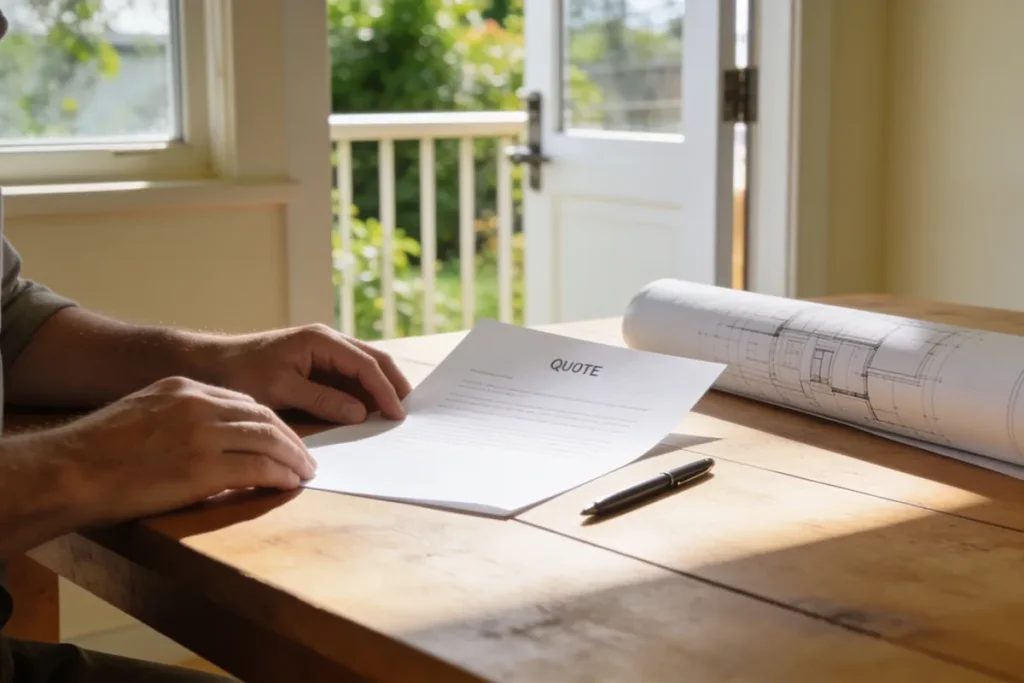
The asymmetry before you sign
A licensed builder who works on renovations has run the contracting process many times in a normal year. Most homeowners run it once in a decade, often for the largest single purchase they will make after the house itself. That asymmetry is why the questions in this article belong before the signature, not after the first variation arrives.
The checklist has one job: to turn a quoted price into a defined scope, a defined timeline and a defined remedy if something goes wrong. None of those three exists until it is written down. A price on its own is not a contract, and a handshake on a figure is not protection.
Nothing here is a warning against builders. A good builder runs a professional business and is not threatened by a homeowner who asks to see a licence, an insurance certificate and a contract that names the inclusions. The builders who resist those questions are the reason the list exists.
One note before the questions. This is general information, not legal advice. Domestic building work in Australia is regulated state by state, the figures and rules differ across jurisdictions, and the relevant state or territory regulator is the authority to confirm against before relying on any of it.
Licence and registration: check before any money moves
Domestic building work in Australia is regulated by the states and territories, and the licence that authorises a builder to contract for it is issued by a regulator. The names are familiar in the larger states: NSW Fair Trading in New South Wales, the Victorian Building Authority in Victoria, the Queensland Building and Construction Commission in Queensland, with an equivalent body in every state and territory. The reader’s own regulator is the one that matters.
The check costs nothing and takes minutes. Ask for the builder’s full name and licence number, then look both up on the regulator’s public register. The full name matters as much as the number, because a builder can trade under a business name that differs from the licensed entity, and the contract should be with the entity that holds the licence. A mismatch between the licence, the business name and the contract is worth resolving before any money changes hands.
A builder’s licence does not cover every trade. Electrical, plumbing and gas work each carry their own licensing in most states, and a builder who holds the head contract usually arranges licensed sub-contractors for that work. Ask who holds those licences and confirm them the same way.
- The builder’s full name and licence number, matched to the name on the contract.
- The regulator that issued the licence, so both can be checked on the public register.
- The licences held by sub-contractors for the electrical, plumbing and gas work.
Home indemnity insurance: the cover the builder should hold
Home indemnity insurance, called home warranty insurance in some states, is the protection that exists if the builder dies, disappears or becomes insolvent before the work is finished or during the defects period. It is the most under-asked question in the builder-owned guides, and it protects the homeowner in precisely the situation nobody wants to picture: a half-finished job and a builder who can no longer finish it.
The cover is compulsory for most residential building work over a state-set threshold. That threshold is commonly around $20,000 in many states, but the figure differs by jurisdiction and so do the names of the schemes, so treat the number as a guide. The instruction is to ask for the certificate and to confirm the current threshold with the state or territory authority.
Two details decide how much protection the certificate actually gives. It should be issued in the homeowner’s name, because the homeowner is the person the policy protects, not the builder. And it should be in hand before the contract is signed or a deposit is paid. A builder who says the insurance will be organised once work begins has put the question in the wrong order.
- A copy of the home indemnity certificate issued in the homeowner’s name.
- The insurer and the policy number, so the cover can be confirmed directly if needed.
- The threshold that applies in the relevant state or territory, confirmed with the authority, when the value of the work sits near it.
The contract: fixed price, cost plus and what is included
Most domestic building contracts sit on one of two pricing models, and the difference between them is mostly a difference in who carries the financial risk.
Under a fixed-price contract, the builder carries the risk that the job costs more than the quote. The price is set against a defined scope, and the homeowner’s exposure is limited to that price plus any agreed variations. Under a cost-plus contract, the homeowner pays the builder’s costs plus a margin, and the financial risk sits with the homeowner. A builder who prefers cost-plus is not automatically a poor choice, but the reasons for that preference matter, because the risk transfer is real: when the job runs over, the overrun lands on the homeowner.
| Fixed-price contract | Cost-plus contract | |
|---|---|---|
| Who carries the cost risk | The builder, against a defined scope. The homeowner’s exposure is the contract price plus agreed variations | The homeowner. The builder’s costs plus margin pass through, so an overrun lands on the homeowner |
| How changes are priced | Each variation is priced and agreed before the work, then added to the contract | Changes are often charged at cost plus margin as the work proceeds, with less incentive to keep them down |
| When each tends to suit | A defined job with clear plans, inclusions and scope, where a price can genuinely be fixed | A job where the scope cannot be fully defined up front, and the builder is open about that uncertainty |
The contract should be read as more than the price. A proper domestic building contract in most states names the parties in their licensed identities and describes the work by reference to the plans and specifications. In practice the drawings are part of the contract, so a change to them is a change to the scope. The contract also carries an inclusions list and an exclusions list, provisional sums and prime cost items for materials not yet chosen, and a schedule of finishes.
A provisional sum is an allowance for work that cannot be priced when the contract is signed, and a prime cost item is an allowance for a material that has not yet been chosen, such as tiles or tapware. When the real figure lands, the difference is adjusted against the contract, so an allowance that sits unrealistically low does not reduce the price so much as move the cost into a later variation.
The inclusions list gets the attention, and the exclusions list deserves as much, because it is where costs have a habit of reappearing. Read the two against the quote line by line, and ask what happens if a specified item is discontinued, because the answer decides whether the replacement is the builder’s cost or the homeowner’s.
Variations: the clause that decides the final bill
A variation is any change to the agreed scope after the contract is signed, and the clause that governs it is the one most likely to decide the final bill. The fair handling of a variation is standard in most contracts: in writing, priced, and signed by both parties before the work is done. A change agreed in passing and discovered later on the invoice is the pattern homeowners most often report regretting.
Underquoting is the sharper form of the same risk, and its warning signs are consistent in homeowner accounts: a quote that sits well below the others with no obvious reason, extras that begin to appear once the job is under way, and a contractor who treats every question about scope as an opening to add to the price. No single sign is proof of bad faith on its own. Together they are a reason to slow down and ask for detail.
A fair contract also distinguishes two kinds of change. When the homeowner asks for something new, a priced variation is reasonable. When the builder corrects an error in the plans or specifications, the correction should be the builder’s cost, not a variation. The contract should say which is which. Because small unforeseeable items do arise on real builds, a contingency held back for exactly that, commonly a small percentage of the budget, is the homeowner’s buffer rather than the builder’s margin.
Payment schedules and progress claims
The way a contract schedules money is the clearest test of how the builder treats the relationship. The deposit is the first question. Many states cap deposits on domestic building work, with a common ceiling in the range of 5 to 10 per cent of the contract price. The limit differs by state and can vary with the size and type of the job, so the range is a guide and the state rules are the authority. A request for a deposit well above the cap is a reason to ask which cap applies.
Progress payments should be tied to completed and inspectable stages of the work, not to the calendar. A payment released on a defined stage, such as frame or lock-up, means something when the stage is written into the contract and can be inspected before the money moves. A schedule that pays by date, or that fronts a large share of the price early, shifts risk to the homeowner without adding anything in return. The homeowner should be able to see the stage before paying for it.
The final payment is the point of greatest leverage and should come last in every sense: after practical completion, after the handover walk-through, and after the items on the defects list have been fixed. Paying it before the defects are resolved removes the only pressure the homeowner holds to see them finished.
- The deposit amount, and the cap that applies to domestic building work in the relevant state.
- What each progress payment is tied to, and which stage must be complete and inspectable before it is paid.
- When the final payment falls due, and confirmation that it comes after practical completion and the clearing of the defects list.
Who is on site, and the timeline
The name on the contract is the builder, but the person on site day to day may be someone else. Ask who will actually run the job, whether the licensed builder or a site supervisor, and who is there on a day-to-day basis. Ask which trades are direct employees and which are sub-contracted. A job that passes between the contract, a supervisor and a string of sub-contractors is harder to hold accountable than one with a clear chain of responsibility.
The timeline belongs in the contract. A start date and a finish date, or a defined period, give the homeowner something to measure against, and the clause that gives those dates force is the one that says what happens if the builder runs late. Some contracts name delay damages or give the homeowner the right to end the contract after a defined period. A contract that states a date but says nothing about lateness has not actually promised the date.
If the builder does become insolvent part way through the work, the protection that exists for exactly that event is the home indemnity insurance covered earlier in this article. That is what the cover is for.
Defects, warranties and the handover
Quality is not entirely a matter of the builder’s goodwill. In most states, statutory warranties are implied into residential building work: the work will be done with due care and skill, the materials will be suitable for the purpose, and the home will be fit for its purpose when finished. These warranties generally cannot be contracted away, so a contract cannot simply disclaim them in the fine print.
The defects liability period is the practical window for fixing what is wrong after handover. Many contracts run it for around three months for non-structural defects, with structural elements carrying longer warranties measured in years. The length is set by the contract and by the state’s rules, so the numbers here are a shape rather than a rule. What matters is that the period is written down, and that the process for listing defects at handover is clear before the keys change hands.
The final walk-through before the last payment is the homeowner’s last lever, and it should be treated as one. Walk the finished work against the contract, list the defects in writing, agree on a date for them to be fixed, and only then release the final payment. After that payment the defects period and the statutory warranties are the remaining protection, which is one more reason to get the insurance certificate and the contract right at the start.
Before you sign
The order of operations runs as a sequence rather than a menu, and it is this article in miniature:
- Verify the licence on the state or territory regulator’s public register, in the exact name that will appear on the contract.
- Ask for the home indemnity certificate, issued in the homeowner’s name, before anything is signed or paid.
- Read the inclusions and the exclusions together, line by line, against the quote.
- Keep every variation written, priced and signed before the work is done.
- Tie each progress payment to a completed and inspectable stage, and hold the final payment until the defects list is cleared.
A builder who resists these questions is answering them. No checklist can guarantee a build free of problems, and none of this is a promise that nothing will go wrong. What the sequence does is make sure that when something does go wrong, the homeowner is not discovering for the first time that the contract does not cover it.
Sources: NSW Fair Trading, questions to ask before hiring a tradesperson or builder · State building regulators (VBA, QBCC, NSW Fair Trading), licence checks and home indemnity insurance · Housing Industry Association (HIA), understanding your building contract
