
Wheel Alignment Is Measured, So Ask for the Printout From Before and After
- Automotive
-
Nov 09
- Share post
 Konrad Eisfeld

A wheel alignment is a measurement before it is a repair. The machine that does the job records each angle, and the report it produces is the only record of what was out and what the shop changed. Our position is that you should ask for the printout from before and after, and read each value against its range before you pay.
One limit belongs up front. We found no regulator, standard or consumer-law page that gives a customer a right to that printout, so it is a reasonable request and not an entitlement. The case for asking rests on what the sheet contains, as motoring and trade sources describe it.
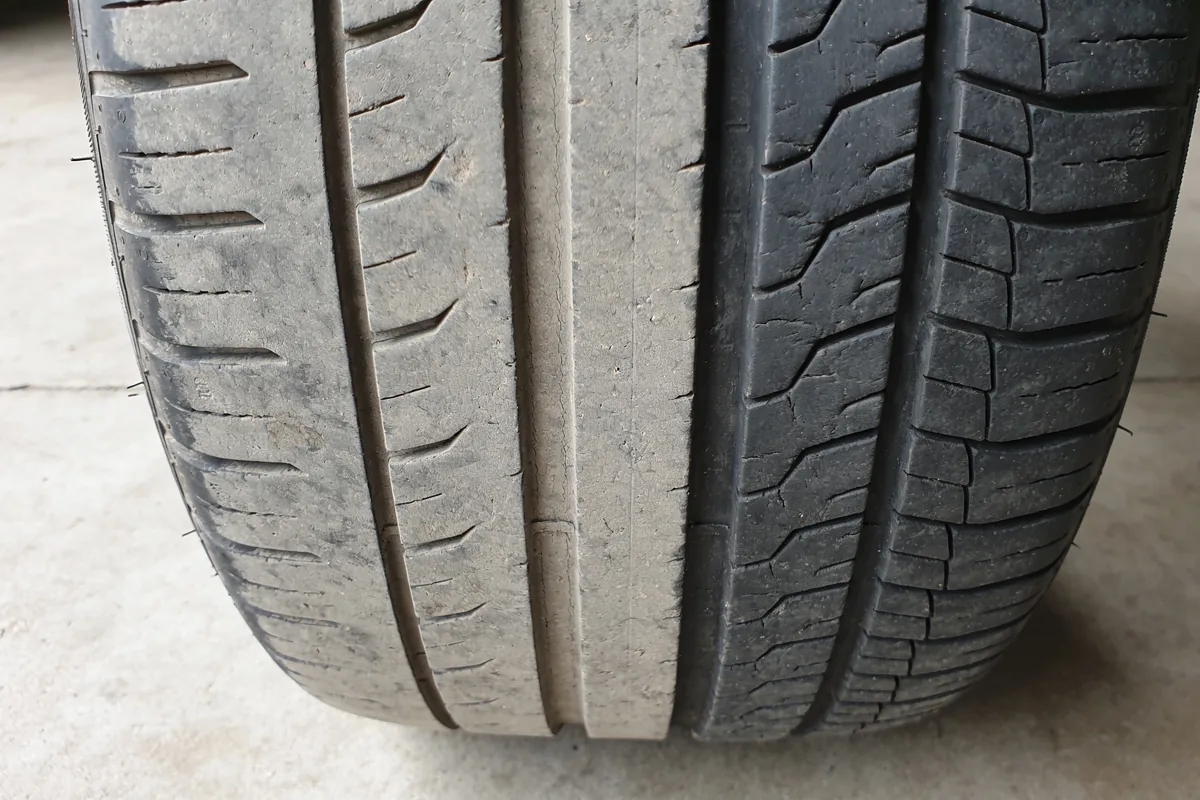
The sheet reports three angles that matter most: camber, toe and caster. A state motoring body, in an explainer published in January 2025 and updated in July 2025, describes alignment as small adjustments so that all four wheels sit parallel to one another and perpendicular to the ground. This guide sets out what each angle does to a tyre, how to read the columns, what a good printout flags, the order a shop should work in, and what to ask before you book.
What the machine measures, and what each angle does to a tyre
Five readings account for most of a typical sheet. The table sets out what each one is and what it does to a tyre, using a suspension parts maker’s guide to reading an alignment report (September 2022) and a US trade publication for repairers (2 September 2025).
| Reading | What it is | Wear or handling effect | Adjustable? |
|---|---|---|---|
| Camber | The inward or outward tilt of the top of the tyre | Positive camber wears the outer edges, negative camber the inner edges | Sometimes. May need eccentric cams or shims. Most vehicle specs run camber close to 0 degrees |
| Toe | The direction the wheels point relative to each other, in degrees, or sometimes millimetres or inches | Toe-in wears the outer tyre edges, toe-out the inner edges | Usually, by changing tie rod length |
| Caster | The forward or rearward tilt of the steering axis | Helps the wheel return to centre and steadies the car at speed | Often not. Most of today’s vehicles have no caster adjustment |
| Thrust angle | The direction the rear wheels push relative to the vehicle centreline | An incorrect angle causes poor alignment and “dog-tracking” or “crab-walking” | Set through the rear alignment, and checked first on a four-wheel job |
| Steer ahead | Whether the steering wheel is centred | The wheel can read centred while total toe is out of specification | Follows toe: in the parts maker’s example, fixing the toe angles corrected the steer-ahead reading |
Two notes qualify that table. The first is that not every angle is adjustable on every car. The parts maker’s guide says: “While not all alignment angles are adjustable on all vehicles, there may be aftermarket solutions available.” Camber may call for eccentric cams or shims, and caster may call for subframe movement or radius or strut rods. The second is that the numbers you are measured against belong to your car. The motoring body’s explainer says: “Correct alignment angles will be specified in your car’s manual.” The parts maker’s guide adds that specifications are dictated by the vehicle year, make, model and trim options.
The motoring body also lists what knocks wheels out of line: impacts such as running into a kerb or driving over potholes, normal wear, and suspension or steering work.
How to read the sheet
An alignment report is laid out by axle, with front and rear sections and a left and right reading for each. It has three kinds of column.
Before Measurements is the pre-adjustment reading: the car as it arrived, before any correction. Current Measurements is the post-adjustment reading, which is the car as it left. The third kind is the specification: a minimum and a maximum for each value, plus a preferred setting. On the parts maker’s guide’s example report, green marks the preferred range.
Two cautions apply. Toe may be shown in degrees or in millimetres or inches, and a millimetre figure needs the rim size to convert, so do not compare a number in one unit with a range in another. Colour schemes also vary. The trade publication’s example reports use red, yellow and green flags to show where adjustment is needed, but the exact scheme differs between machines. Ask what the colours mean on that machine. For the same reason, ask about sign conventions (whether a negative figure means in or out) rather than assuming.
The table below is an invented example, built to show four outcomes an owner should be able to tell apart. The figures are for illustration only. They are not any vehicle’s specification.
Illustrative example only: invented figures
| Reading | Before | After | Range (min to max) | What the row says |
|---|---|---|---|---|
| Front total toe | 0.62 deg | 0.06 deg | -0.10 to 0.20 deg | Out before, inside after and near the middle: the one fix the shop made |
| Front camber, left | -0.40 deg | -0.40 deg | -1.20 to 0.20 deg | Inside before and after, left alone: nothing to fix |
| Front camber, right | -1.15 deg | -1.15 deg | -1.20 to 0.20 deg | Inside, but on the edge of the range: ask whether it was adjustable |
| Rear total toe | 0.35 deg | 0.35 deg | -0.15 to 0.15 deg | Still out after: should be flagged as not adjustable, with the part that would fix it |
| Steering wheel angle | 2.0 deg | 0.0 deg | -0.5 to 0.5 deg | Centred after: was crooked before |
Read it row by row. The first row is the clean result, a value that moved from outside the range to inside it. The second needed no work, and a shop that leaves it alone has done the right thing. The third passes on paper, but sits at the limit, and it is the row worth a question. The fourth is the one a sheet should never leave unexplained: a value still outside its range after the job. The last shows the car leaving with the steering wheel centred.
Four things a good printout shows
A printout is a record of measurement. It does not prove the work was done well, and it says nothing about workmanship you cannot see on a screen. Within that limit, four features separate a useful sheet from a token one.
- Both a before and an after reading. Without the first, you cannot tell what was out. Without the second, you cannot tell what changed.
- Every angle the car can have measured, front and rear. The parts maker’s guide says a four-wheel alignment is not always needed, but the rear alignment and thrust line should always be verified.
- After values inside the range, ideally near the middle. The parts maker’s guide says adjustments should “split the difference between the Min and Max specifications”. A value that passes only by sitting at the edge has little margin.
- A flag on anything that could not be brought into range. That means the reason, and the part that would fix it. The steering wheel should read centred, too. If the equipment refused to proceed because toe was too far out (the trade publication notes most equipment will not allow it), that points to worn parts, and it is a conversation about repair before it is a conversation about alignment.
What gets checked and adjusted first
The order of work matters because each step affects the next. The two technical pages agree on the shape of it but not on every detail: the parts maker’s guide sets rear camber and rear toe before the front caster, camber and toe, while the trade publication sets caster, camber and rear toe first, then centres the steering wheel and adjusts front toe. Treat the table as the general shape, not a rule.
| Step | What happens | Why it comes there |
|---|---|---|
| 1 | Road test and visual inspection | Done before the car goes on the rack (trade publication) |
| 2 | Check steering and suspension for looseness | “You cannot perform a four-wheel alignment on a vehicle with defective parts” (trade publication) |
| 3 | Pre-alignment checks: tyres, load, curb height | The car must be ready to hold the alignment. An overloaded vehicle lowers the rear suspension and changes camber |
| 4 | Before reading taken and printed | Records what was out |
| 5 | Four-wheel job: thrust line, then rear camber, then rear toe | The thrust line is checked first, then the rear is adjusted (parts maker’s guide) |
| 6 | Front caster, camber and toe | The front follows the rear (parts maker’s guide) |
| 7 | Steering wheel centred and checked | The trade publication centres the wheel before it sets front toe, then re-centres and re-adjusts toe so the wheel sits straight when driving |
| 8 | After reading taken and printed | Records what changed |
Step 2 overlaps with another job. Steering and suspension wear also turns up in a pre-purchase car inspection, where the report carries a “Suspension and steering” line. Worn parts matter in both places.
One more item belongs in this section. The trade publication tells technicians to check the shop manual for driver-assist recalibration requirements, especially when toe or thrust angle changes. If your car has driver-assist cameras or sensors, ask whether anything needs checking afterwards.
What to ask before you book
An alignment is done on a workshop rack, which is why it sits with the jobs a driveway or mobile mechanic cannot do, as the mobile mechanic versus workshop guide on this site explains. When you phone around the auto mechanics on the site, five questions cover the ground.
- Is this a two-wheel or four-wheel alignment?
- Will you print the before and after readings, and let me keep both?
- Is a worn-parts inspection included before you measure?
- What happens if a value cannot be adjusted?
- Does this car have driver-assist cameras that need checking afterwards?
A fair point sits on the other side. A bundled or discounted alignment from a tyre supplier can be good value, and nothing we read says it is a lesser job. The printout is how you tell, not a reason to avoid the bundle. Ask for the same sheet whatever the deal.
Read the numbers, then pay
The printout records measurement, not workmanship. Compare each after value with its range, ask about any line that is still out, and keep a copy with the car’s service history. If a shop cannot show you what it measured and what it changed, it is asking you to pay on trust, and the sheet is a fair thing to ask for.
Sources: A state motoring body’s explainer on wheel balance and wheel alignment, published Jan 2025, updated Jul 2025; A suspension parts maker’s guide to reading a wheel alignment report, Sep 2022; A US trade publication’s article on alignment fundamentals for repairers, 2 Sep 2025