
The Tree Job That Needs a Permit: Hiring an Arborist Without a Council Fine
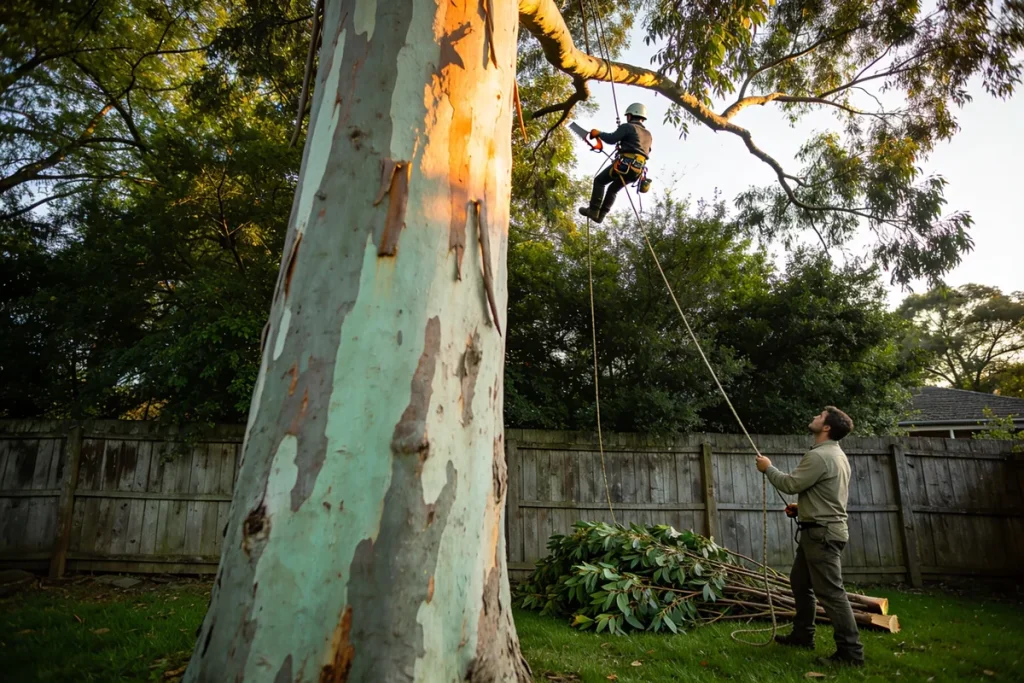
It has been a blowy week, and the big gum over the back fence has been creaking in a way you have not heard before. Perhaps a limb came down on the lawn overnight, or perhaps the tree just looks taller and heavier than it did last spring. Either way, you would like someone up there soon, and that is a perfectly sensible thing to want. Before you ring anyone, though, it helps to know why the permit question comes first: tree rules differ from one council to the next, and they can decide what anyone is allowed to cut, however good the arborist you hire. The short helper below will point you to your first step.
Arborist, permit or council first?
Answer up to four quick questions and get your first step.
If this helper has not loaded: work out whose tree it is, then check your council's tree rules before anyone cuts. Rules differ by council: check yours before work starts.
Answer the questions and your first step will appear here.
This is general information, not legal advice. Your council has the final word on its own trees and rules.
Rules differ by council: check yours before work starts.
Arborist, tree lopper or gardener: what the words mean
If the job titles feel a bit slippery, you are not imagining it. Plenty of people advertise tree work, and the name on the ute does not always tell you much about the training behind it.
A qualified arborist holds at least a Certificate III in Arboriculture, which sits at AQF Level 3. That is the person you want up the tree with the saw and the ropes. A consulting arborist does a slightly different job. They usually hold the Diploma of Arboriculture, at AQF Level 5, and training.gov.au describes that qualification as the one for assessing trees and producing reports. So if a council asks you for an arborist report, the consulting arborist is generally the person who writes it.
“Tree lopper” is a name you will see on lots of ads, and it is worth gently asking what qualification sits behind it. The word itself carries more weight than you might expect, too. Lopping and topping are named in the rules as acts that need approval. The City of Sydney’s development control plan names them, and Victoria’s clause 52.37 talks about a permit to “remove, destroy or lop” a canopy tree. So a quote that offers to “lop it back a bit” is describing exactly the kind of work a council may want to hear about first.
A gardener is lovely for hedges, shrubs and tidy-ups you can reach from the ground. For anything tall, heavy or leaning towards the house, you will usually want an arborist.
Whose tree is it?
It might feel like an odd place to start, but it saves a surprising amount of bother.
A street tree or a nature-strip tree belongs to the council. Ring them, tell them what you have noticed, and leave it alone, even if it keeps dropping twigs on the car. Pruning or removing it yourself is off the table.
A neighbour’s tree is a conversation before it is a job. Have a friendly chat over the fence first, and check your council’s tree rules before anyone cuts anything. It can feel awkward to raise, but an easy word over the fence now beats a cross one after the branch comes down.
Your own tree is where most of the questions live, so read on.
Does it need a permit? Three real examples
This is the part where it pays to slow down. There is no single answer that covers everywhere, so rather than guessing, it helps to see how three real sets of rules work. Use them to learn the method, then look up your own council’s.
Victoria, statewide: clause 52.37
Victoria introduced clause 52.37 (Canopy trees) through Amendment VC289 on 15 September 2025. It applies in most residential zones, though not the Low Density Residential Zone. The Victorian Government’s guide describes a canopy tree using three measures:
- more than 5 m high
- a trunk circumference of more than 0.5 m, measured 1.4 m above the ground
- a canopy diameter of at least 4 m
Where the permit applies depends on your block. On a lot with an existing house and no development, it applies within 6 m of the narrowest street frontage and within 4.5 m of the rear boundary. On vacant land, it applies anywhere on the lot.
City of Boroondara: the Tree Protection Local Law
Boroondara has its own local law as well. Under it, a canopy tree is one with a trunk circumference of 110 cm or more at 1.4 m above the ground, or 150 cm or more at ground level. You need a permit to remove one, and you also need one to work within 2 m of it. That second part is worth reading twice, because it reaches beyond the tree itself to the ground around it, so keep it in mind if you are planning any work close by.
If you have seen a different measuring height quoted for Boroondara somewhere else, go with the council’s own page. It says 1.4 m.
City of Sydney: Sydney DCP 2012, section 3.5.3
In the City of Sydney, the Sydney DCP 2012, section 3.5.3 sets out when you need a permit or consent. It applies to a tree that is 5 m or taller, has a canopy spread of more than 5 m, has a trunk diameter of more than 300 mm at ground level, or is on the Register of Significant Trees. Pruning can be exempt, but only within limits: no more than 5% of the canopy, among other conditions.
You might notice that Sydney talks about trunk diameter, while the two Victorian examples talk about circumference. They are different measurements, so read each council’s numbers against its own wording rather than lining them up side by side.
The method for your own council
Wherever you live, the steps are the same:
- Search “[your council] tree permit” and open the council’s own page, not a summary of it.
- Check whether any planning overlays on your property protect trees or vegetation.
- If anything is unclear, ring the council and ask. A quick call now is far easier than sorting things out once the tree is on the ground.
What a fine looks like
Nobody enjoys this section, so I will keep it calm. It is here to explain why the order matters, not to frighten you.
In Boroondara, the fine is $4,070.20 per offence under the Tree Protection Local Law 2024. In the City of Sydney, maximum penalties go up to $500,000 for individuals and $2 million for companies.
Those numbers are worth holding next to the application fees in the next section. Once you see them side by side, the case for asking first more or less makes itself, and it takes some of the pressure off. Checking first protects you, and a good arborist will be glad you did.
Applying, and what council asks for
If it turns out you do need a permit, the process may be more manageable than you fear. Here is how the two councils above handle it.
Boroondara: the application fee to remove a canopy or significant tree is $226.90. The council makes a decision within 10 business days, unless it needs more information from you, and a permit is valid for 12 months. You will need a site plan and photos with your application, so it is worth taking those on a clear day before you sit down to fill in the form.
City of Sydney: the application fee is $98, and applications are assessed within 28 days.
Whichever council you are dealing with, sort out one small thing early: who lodges the application. Agree in writing whether you or your arborist will do it. It sounds fussy, but it heads off the “I thought you were doing that” moment, where the saw is booked and the permit has not gone in.
Vetting the arborist
Once you know what the rules allow, choosing the arborist gets much easier, because you know exactly what you are asking them to do.
Match the qualification to the job. The work itself calls for a qualified arborist at AQF Level 3 or above, and the City of Sydney’s apply page says all tree works need at least that level. A report calls for a consulting arborist at AQF Level 5. It is the same idea as matching a handyman or a licensed specialist to the job in front of you: the right qualification for the work, not just the first person free.
Ask for insurance in writing. A cheerful “yes, we’re covered” on the phone is not something you can put in a folder.
Get a written quote that names everything. A good quote should spell out:
- which tree, described clearly enough that nobody could cut the wrong one
- exactly what work will be done
- pruning to “the relevant Australian Standard for the Pruning of Amenity Trees”, rather than lopping
- stump removal and green waste, and whether they take it away or leave it for you
- who handles the permit
If the green waste is staying with you, have a plan for it before the day. Branches and stumps pile up quicker than you think, and hiring a skip bin for green waste can save a lot of trips to the tip.
Notice the red flags. Be cautious about anyone who says “no permit needed” without first asking where you live, anyone who will only take cash, and anyone door-knocking straight after a storm. None of these automatically means a bad operator, but each one is a good reason to slow down and ask a few more questions.
If they find something else. Now and then an arborist will spot termite damage in timber while they are working. That is a separate job for a pest inspection, and vetting a pest control company comes with its own short list of checks.
When it cannot wait
Sometimes there is no time for any of this, and that is okay. People come first.
- If a life is at risk, call 000.
- For storm damage in NSW, call the SES on 132 500. In other states, check your state SES for the right number.
- Stay well clear of powerlines, and keep everyone else clear too.
- Take photos of everything, and tell your council afterwards.
Getting everyone safe is the job in that moment. The council conversation can follow, and your photos will help you explain what happened and why.
Before the chainsaw starts
If you have read this far with one eye on that gum tree, you are already doing the sensible thing. Start with whose tree it is. Then check what your council’s rules say about it, using the council’s own page and a phone call if you need one. Only then hire an arborist whose qualification fits the job, with insurance in writing and a quote that names the tree and the work.
In that order, the tree work tends to be the easy part. Rules differ by council, so check yours before work starts.
Sources: Victorian Government, Protecting and enhancing our tree canopy for a greener Victoria (https://www.planning.vic.gov.au/guides-and-resources/guides/all-guides/protecting-and-enhancing-our-tree-canopy-for-a-greener-victoria); City of Boroondara, Apply for a Tree Protection Local Law permit (https://boroondara.vic.gov.au/waste-environment/trees-and-naturestrips/apply-tree-protection-local-law-permit); City of Sydney, Apply to prune or remove a tree (https://www.cityofsydney.nsw.gov.au/property-tree-maintenance/apply-prune-remove-tree)