
Hiring a Jumping Castle: The Safety Standard, the Anchoring and the Insurance
 Tahlia Wrenwood
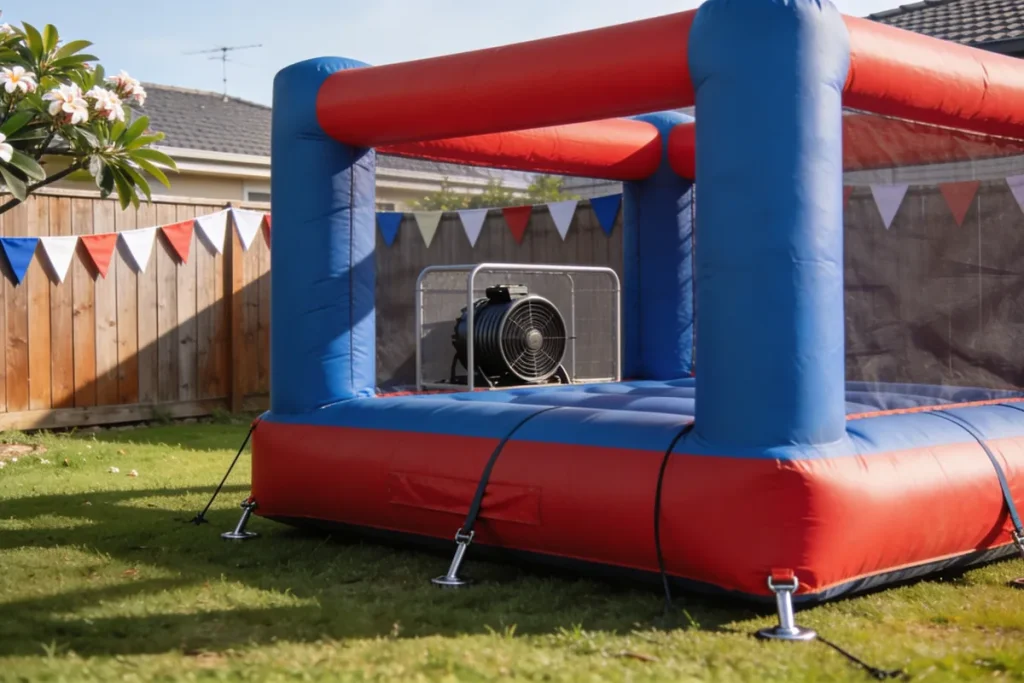
If you are planning a backyard birthday or an end-of-year party and a jumping castle is on the list, you are in for one of the happiest sounds a party can make: a dozen kids bouncing and shrieking at once. You might also have a small worry sitting quietly at the back of your mind, especially if you have seen a news story about an inflatable going wrong. That worry is fair, and it is also something you can do a lot about. A well-anchored, properly supervised castle on a calm day is the normal, uneventful outcome, and the checks that get you there are simple once you know them. The checklist below covers the main ones, and the rest of this guide explains each in turn.
Hire-day jumping castle checks
0 of 11 checkedTick these off when you book and again when the castle arrives.
The standard and the manual
It helps to know there is a proper rulebook behind all this, so you are not making it up as you go.
WorkSafe Victoria points operators of inflatable devices to Australian Standard AS 3533.4.1 for how they should be anchored. You do not need to read the standard yourself. What matters is that the hire company knows it and follows it.
The other document that matters is the manufacturer’s operations manual for the castle itself. According to WorkSafe Victoria, that manual should explain how the device is anchored on different surfaces, such as turf or a hard surface like concrete, and the maximum wind speed its anchoring is rated for. Every castle is different, which is why the manual matters more than any general rule you might read online.
So when you ring around for jumping castle hire, it is perfectly reasonable to ask two gentle questions: “Do you anchor to AS 3533.4.1?” and “What does the manual say about anchoring and wind for the castle I’m booking?” A good hire company will have the answers ready and will probably be pleased you asked.
While you are on the phone, you might also ask how the castles are cleaned and checked between hires, and what happens if a seam or a strap is found to be damaged on the day. A company that has a routine for this will describe it without much thought. If the answers feel vague, it is fine to keep ringing around until you find one that sounds like it takes the job as seriously as you do.
Anchoring and wind
This is the part that matters most, so it is worth taking slowly.
WorkSafe Victoria is very clear that inflatables need adequate anchoring even when only light winds are forecast, and even when the castle is not in use. Its guidance notes that young children have been killed or seriously injured when inadequately anchored castles were lifted by gusts. That is hard to read, and I will not dwell on it, but it is the reason every one of the checks below exists.
Here is what good anchoring looks like on the day:
- Castles have several anchor points around the base, and every one of them should be secured, including the awkward ones behind the blower.
- The anchor should suit the surface. On grass, that usually means ground pegs driven in properly. On a hard surface, it means weights rated for the job. The manual says which, and the installer should follow it.
- Someone keeps an eye on the wind. WorkSafe Victoria’s guidance includes measuring the wind on site and deflating the castle when wind is likely to exceed the speed it is rated for. Ask the hire company how they do that, and who on the day will be watching.
You might notice there is no single wind number in this guide. That is deliberate. The safe limit depends on the castle and its manual, so the right number for your party is the one the hire company gives you for that castle. Write it down, and if the afternoon turns gusty, it is completely okay to deflate early. The kids will recover from a shorter bounce far more easily than anyone recovers from the alternative.
When the installer arrives on the morning of the party, it is worth walking around the castle with them before they leave. You do not need to inspect anything technical. Just look at each anchor point together, ask what the castle’s rated wind speed is if you have not already been told, and ask what they would like you to do if the wind rises or the castle starts to lose shape. If the castle is being dropped off rather than staffed, ask them to show you how to switch off the blower and deflate it safely. Two minutes of that conversation means you are not working it out in a hurry later.
The blower and the space around it
The blower keeps the castle up, and it needs a little care too.
WorkSafe Victoria notes that people have been injured by fans without guards, so check that the blower’s fan is guarded and that small hands cannot reach it. Look at where the power lead runs. It should be out of the way of running children and not stretched across a path where someone could trip, and it should not be sitting in water.
Then look at the space. A soft landing area around the entrance helps, and the castle should sit well clear of fences, trees, garden edges, overhead wires and, very importantly, any pool. Kids tumbling out of a castle are not looking where they are going. If your party is near the pool, this site’s guide to getting the pool serviced before summer is a good reminder that the pool fence and gate need to be in good order before a crowd of children arrives.
Flat ground matters as well. If your yard slopes, mention it when you book. The hire company can tell you whether the castle can be set up safely there or whether another spot would be better.
Insurance and the paperwork
It can feel a little awkward to ask a small business for its paperwork, but this is a normal request and a good operator will expect it.
Ask for a copy of the company’s public liability certificate of currency, which shows the insurance is current on the date of your party. Ask for a written hire agreement that sets out who sets the castle up and takes it down, whether an attendant is included, what conditions of use apply and what happens if the weather turns. If you are also booking food for the party, the same written approach works well there, and this site’s questions to ask a caterer cover that side.
If you are in Victoria, there is one more question that may apply. WorkSafe Victoria says that land-borne inflatable devices with a platform height of 3 metres or more, which rely on a continuous flow of blown air, may need their design registered. If you are hiring a larger inflatable, it is reasonable to ask the company whether registration applies and whether the device has it. Outside Victoria, ask the company what applies in your state.
Who supervises
However good the anchoring is, a castle still needs a grown-up watching it.
Some castles are hired with an attendant who stays for the party. Many are dropped off and collected, which means the supervision is up to you. Either way, choose a named adult to be on castle duty at any given time, and swap them over so nobody is watching for hours on end. It is easy for everyone to assume someone else is keeping an eye on things, so naming the person helps.
The manual should say how many children can be on the castle at once and the age range it suits. Keep to it, and try to keep similar-sized children together, so the little ones are not bouncing alongside much bigger kids. It also helps to set a few simple rules before the first child climbs in:
- shoes off
- no food, drinks or lollies on the castle
- no climbing on the walls or sliding off the sides
- everyone off if the adult on duty says so
Little ones generally take these rules well when they hear them early and cheerfully, and the adult on duty has an easy job enforcing them.
If the party falls on a hot summer day, plan a few breaks in the shade with water for everyone, and think about timing the castle for the cooler part of the day. Bouncing is hard work, and tired, overheated children are more likely to bump into each other.
Pegged, rated and watched
You do not need to become an expert to keep a jumping castle safe. Ask for the public liability certificate and a written hire agreement. Check that the company anchors to AS 3533.4.1 and the castle’s manual, that every anchor point is used and that you know the castle’s rated wind speed. Make sure the fan is guarded, the lead is tidy and the castle is clear of pools, fences, trees and wires. Then name an adult to watch it at all times, keep to the numbers and ages in the manual, and do not hesitate to deflate if the wind picks up.
Once the castle is pegged, you know its rating and someone is watching it, you can let yourself enjoy the noise.
Sources: Land-borne inflatable amusement devices, WorkSafe Victoria (https://www.worksafe.vic.gov.au/land-borne-inflatable-amusement-devices)