
Questions to Ask a Caterer Before You Book: the Menu, the Minimums and the Fine Print
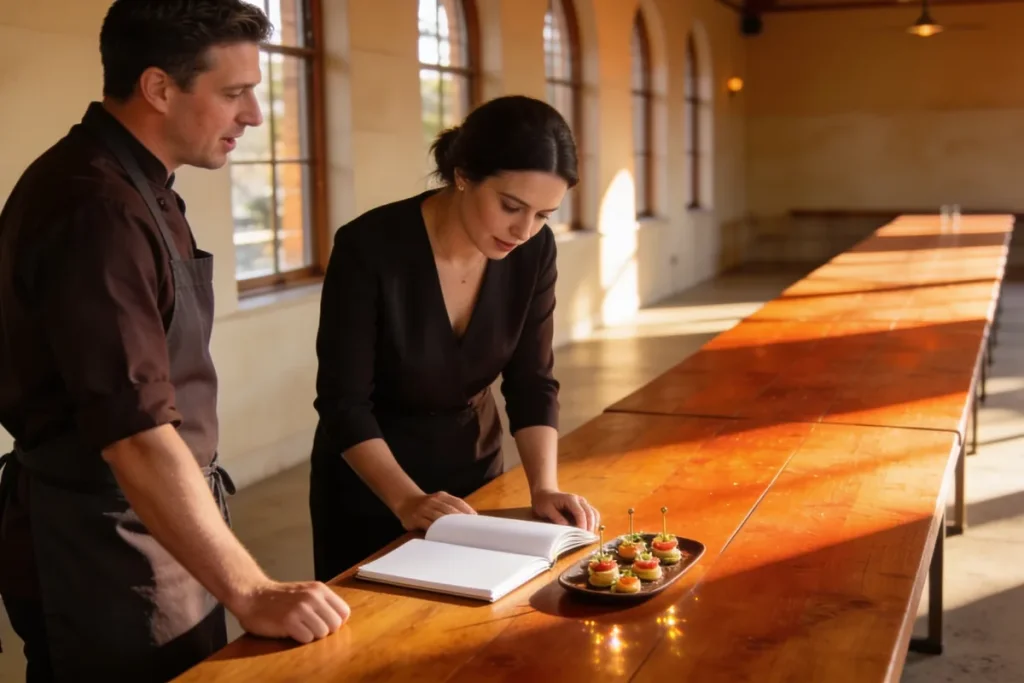
Here is a scene most hosts know. The caterer has laid out samples, the table looks generous, and the food tastes as good as it looks. You are already picturing your guests around it. Then the paperwork comes out, and the numbers on the page do not obviously match the warm experience sitting in front of you.
Booking on enthusiasm is easy, and it is not a character flaw. A good meal does most of a caterer’s persuading for them. But the questions in this article are not there to catch anyone out. A professional caterer is happy to answer all of them, and the way they answer tells you how the working relationship will feel. That matters as much as the menu.
Booking a caterer is also one of the few decisions where the person you choose will be inside your event, working while you host. The relationship is not incidental to the day. It is part of it, which is another reason the conversation matters as much as the tasting.
Most catering regrets are rarely about the food itself. They come from a detail nobody asked about: a minimum guest count that quietly raised the bill, an extra charge for cutlery that arrived on the invoice, an allergy the kitchen only heard about on the day. Each one is a small thing until it is your event, and then it is the only thing.
One note before you start. This is general information, not legal advice. Catering businesses in Australia work under state and territory food safety rules, and serving alcohol has its own requirements, so the caterer and your state food authority are the people to confirm the specifics with.
The checklist below gathers the questions into one place. Work through it as you talk to caterers and you will walk into any booking conversation with the full list in front of you.
What to confirm with a caterer before you book
0 of 11 confirmedThe price
Guest numbers
On the day
Food safety and diets
Alcohol
The paperwork
Start with what the quote actually includes
The most useful question you can ask a caterer is also the most obvious: what exactly is in the per-head price? A figure per guest is only meaningful once you know what it buys. Ask whether it covers food alone or food plus the people who serve it. Ask about crockery, cutlery and glassware, tables and linen, and who sets them up and packs them down. Delivery and travel to the venue can sit outside the quote as well.
None of this is about squeezing the caterer. It is about comparing like with like. Two quotes for the same number of guests can look similar and include very different things, and you can only weigh them side by side when each one says what it covers. A quote that arrives as a single lump sum with no breakdown is not simpler to deal with. It is harder to compare, and it leaves more room for a surprise later.
Ask for the inclusions and the exclusions in writing. It sounds backwards, but the list of what is not included is often the more useful document, because that is where costs have a habit of reappearing. A caterer who names their exclusions unprompted is showing you how they run their business.
One more question earns its place here. If children are part of the guest list, ask how the per-head price applies to them, so the final number does not come as a surprise. And ask whether the quoted price is the price, or whether fixed charges sit on top of the per-head figure. A written quote that shows both the per-head cost and any separate fees is the easiest kind to compare.
Minimums, guest numbers and the deadline
Many caterers quote for a minimum number of guests, even when you might invite fewer. The minimum is not a trap. It reflects the cost of running the event, the staff and the equipment no matter how many people sit down. But it belongs in the conversation before you fall in love with a menu you cannot fill.
Ask what the minimum is, how the price moves as your numbers move, and the date by which you must confirm the final guest count. Guest lists drift. RSVPs come in late, partners appear, a cousin you forgot suddenly says yes. The deadline question is what protects you when that happens, because it tells you how much room you have before the numbers lock in.
A caterer who needs final numbers two weeks out is normal. One who needs them months in advance might have a good reason, and it is worth understanding that reason before you agree, rather than discovering it when your list is still half empty.
Service style and what happens on the day
Plated, buffet, grazing tables and family style each change the experience, the staffing and the equipment. The question is not just which one you prefer. It is what each one actually involves on the day, and whether the quote matches the reality.
Ask who cooks and who serves, and how many staff the quote includes. A plated dinner for eighty needs more hands than a grazing table for the same number, and a caterer who has quoted for fewer staff than the service style needs will be rushing on the night. Ask what happens if a staff member is unwell on the day. Nobody can promise against illness, but a caterer who has a plan for it is a caterer who has thought ahead.
If the event is at home, or at a venue the caterer has not worked before, ask how they handle an unfamiliar kitchen. What access do they need, what power and water do they rely on, and how much time do they need to set up? These questions sound practical and dull. They are the difference between a smooth afternoon and one spent running extension leads.
If the caterer offers a tasting, ask whether it is included in the quote or costs extra, and whether the dishes you taste are the ones you will actually be served on the day. A tasting is a preview. It is only useful if it previews the real menu.
Allergies and dietary needs are a safety conversation
This is the question that matters most, and it deserves to be treated as more than a preference. In Australia, food businesses work under state and territory food safety rules that cover allergen handling. So asking how a caterer manages allergies is a safety question, not a fussy one, and a reputable caterer will have a clear answer ready.
Ask how the kitchen handles allergies, including anaphylaxis. Ask whether dishes are labelled on the day, or how the information reaches the people serving the food, and what guests should do to tell the caterer about a need. Many caterers send out a form before the event, which is a good sign, because it means the information is collected properly rather than hoped for.
Then cover the ordinary requests: vegetarian, gluten free, halal, vegan, and the other needs your guests bring. Ask whether the kitchen can genuinely accommodate them. It is okay to ask directly, and it is okay to hear a clear no before you book. A straight answer up front is far better than a well-meaning kitchen discovering on the day that a dish does not actually work.
It is also fair to ask how the kitchen avoids cross contamination. For a guest with a severe allergy, the risk sits in the surfaces, tools and oil the ingredient touches as much as in the ingredient itself. A caterer who can explain that process plainly is a caterer you can trust with that guest.
Alcohol, the venue, and the parts catering does not control
Alcohol trips up more hosts than the food, because it is the part with rules attached. Ask who holds the authorisation to serve it, the caterer or the venue. The answer shapes what you can and cannot do, and it is not something you want to discover when the bar is about to open.
If it is bring your own, ask how that works. Is there corkage, how is it charged, and does the caterer serve the drinks or simply supply the glasses? Ask whether the caterer has worked at your specific venue, and what they need from you on the day: power, water, access times, parking, a contact who can let them in. These are the details the brochure leaves out, and they are exactly where an event can come unstuck.
None of this is designed to talk you out of booking. It is the opposite. Caterers work at unfamiliar venues all the time, and a good one will walk you through exactly what they need. The host who asks is the host who gets the straight answer.
Ask what time the caterer needs access to the venue and how long set-up takes, so you book the space for long enough. It is the kind of detail that only surfaces later, usually attached to an invoice for an extra hour.
The contract: deposits, cancellations and the date
The paperwork questions are the least romantic part of the process, and they are the part that protects the romance. Ask what the deposit is, when it is due, and what happens to it if you cancel. Ask how cancellations are handled at each stage, and what happens if the date has to move.
Ask whether the menu, the guest count and the quote are locked in writing, or whether any of them can change. A menu that can be swapped at the last minute sounds flexible until you realise the price can move with it. The written quote is the record you both work from, and it should name the menu, the numbers and the inclusions.
A clear contract is the mark of a professional caterer, not a suspicious one. The caterers who resist putting things in writing are the ones worth worrying about, because the writing is what protects both of you when something unexpected happens.
Ask what happens if the caterer has to cancel, not just if you do. A professional has a clear policy for their own side of the arrangement, and how they describe it tells you how they handle their obligations.
Book the caterer who answers well
The menu gets people to the table. The answers are what get you a relaxed event. A caterer who is clear about inclusions, honest about minimums and direct about allergies is telling you how the working relationship will go. One who is vague on any of those is unlikely to become more specific on the day.
Use the checklist to compare two or three local caterers, and book the one who answers like a partner rather than a salesperson. A good event starts with good food and good company. It is held together by the quiet details you confirmed in advance, and those details are yours to ask about. You are allowed to ask for all of them, and you deserve clear answers.
Sources: State and territory food authority guides, food safety and allergens for food businesses · NSW Fair Trading and state consumer affairs, booking services and deposits · Australian event and catering industry guides, catering contracts and quotes