
A Rainwater Tank Quote Should Cover Two Jobs, and Only One of Them Is the Tank
 Konrad Eisfeld
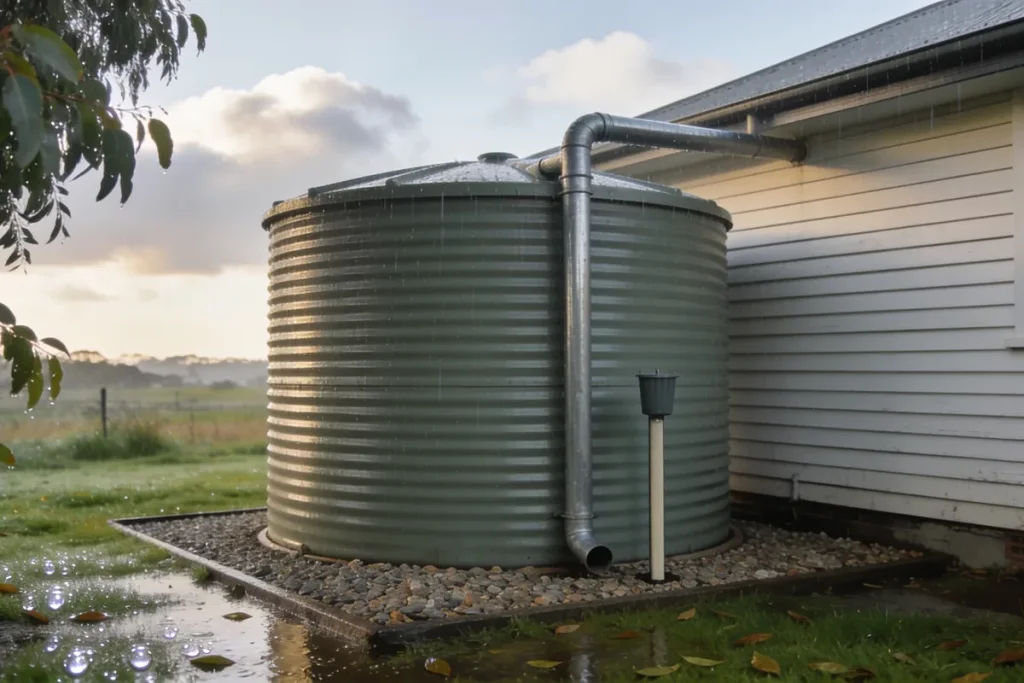
It is mid-September, spring in the southern states, and the dry months are not far off. The tank itself is easy to price, since size, material and colour fill every retail page. The installed price is harder to pin down, because it depends on plumbing that retail pages rarely describe.
The position taken here is that a tank quote covers two jobs. The first is a purchase: the tank. The second is the plumbing that brings water in, carries the overflow away and, where wanted, connects the tank to the house. In Victoria, Queensland and Western Australia the sources read point to a licensed plumber for that second job (in Western Australia, a licensed plumber or the holder of a restricted permit), and the New South Wales page read covers plumbing work generally without mentioning tanks. So ask each quote who holds the licence for it and what certificate is lodged afterwards. Below are who may do which part in four states, how approvals differ, and nine lines a quote should name. This is general information, not advice, and rules differ by state and council.
A tank quote is two jobs
The Victorian Government’s water department lists what needs a licensed plumber: the pipes in and out of the tank, meaning the gutter connections that bring rainwater in and an overflow pipe to the legal point of discharge to the council stormwater drain, and the connection of the tank to toilets, the washing machine or both. The same page says a qualified plumber is required for any work on gutters, downpipes and charged stormwater systems, and that after installation the plumber should provide a certificate of compliance. Queensland points the same way. Business Queensland says a rainwater tank is typically installed by a licensed plumber. Brisbane City Council is firmer: a licensed plumber is required if tank water connects to the toilet or cold-water washing machine tap, and a tank cannot be installed by the owner alone. That is one council’s rule.
One older source disagrees. A consumer buying guide last updated 18 October 2019 says an outdoor-use tank usually needs only the supplier to install it, with a licensed plumber needed to connect to the mains. The guide is almost seven years old, and the Victorian and Business Queensland pages are newer. The ruling here sides with the state pages: ask which licence covers the downpipe and overflow work before accepting a supplier-only install.
There is a fair point on the other side. A supplier’s bundled install is convenient, some suppliers use licensed plumbers, and a supply-only quote is sound if the owner has already lined up a plumber.
Who is licensed to do what
Each cell paraphrases one page, so check the wording at the regulator.
| State | Work the source places with a licence | Paperwork | Page and its date |
|---|---|---|---|
| Victoria | Licensed plumber: pipes in and out of the tank, the overflow, and connection to toilets or the washing machine. Qualified plumber: any work on gutters, downpipes and charged stormwater systems | The plumber should provide a certificate of compliance | Victorian Government water department, updated 20 May 2026 |
| New South Wales | A licence or certificate is needed for plumbing work (the page does not mention tanks) | Plumbers may need to submit Notices of Work and Certificates of Compliance | NSW Government plumbers and drainers page, undated |
| Queensland | Typically a licensed plumber (Business Queensland); a licensed plumber for a toilet or cold-water washing machine connection (Brisbane City Council) | Form 4 where an existing building has a tank connected for indoor use; none for outdoor-only use | Business Queensland, updated 1 Sep 2022 and 10 Jul 2026; Brisbane page undated |
| Western Australia | From 10 February 2025, a plumbing licence or a restricted plumbing permit (rainwater storage) for water supply plumbing from the tank outlet to a building | Not covered in the pages read for this guide | Building and Energy, Industry Bulletin 164, September 2025 |
The Western Australian permit is narrow. It covers work from the tank to the building and not work inside the building, and it is valid for three years. The bulletin says the application window was one year, with no further applications after 10 February 2026.
To check a licence, the Victorian page points readers to the state regulator’s Find a Plumber tool. Elsewhere, use your own state regulator’s register. For South Australia, Tasmania, the ACT and the Northern Territory this guide makes no claim, so read the local regulator’s page.
What the tank itself needs approval for
Approval for the tank is a separate question from the plumber’s licence.
In Queensland, Business Queensland (updated 1 September 2022) says a building approval is needed only where a tank is greater than 10 square metres in plan area and more than 2.4 metres high above ground, both together, in non-cyclone areas, and may be needed in a tropical cyclone area. Council planning schemes may set siting and setbacks.
In New South Wales, an above-ground tank can be exempt development if it meets conditions (NSW Department of Planning, updated 23 March 2026): a maximum of 10,000 litres on land outside the zones the page names, a position behind the building line, and an overflow connected to an existing stormwater system, among others. A tank in foreshore or environmentally sensitive areas is not exempt, and one that misses the conditions needs another approval, such as a development application. Some councils add their own approvals: one NSW council says approval is also needed if a tank is topped up from town water or connected to indoor plumbing (page undated).
Victoria’s water department says to check council planning requirements, particularly for a heritage overlay. For Western Australia, the sources read here carry no approval rule, so ask the council.
One Queensland claim travels badly. One summary says tanks have been compulsory in new Queensland homes since 1 July 2022. Business Queensland’s page (updated 10 July 2026) says a tank is required with a new building only where the local government has been approved to opt in, and is voluntary in all other areas. It lists Toowoomba Regional Council (since 1 September 2014, for some new commercial buildings and new single detached houses on lots over 250 square metres) and Southern Downs Regional Council (from 1 July 2022, for new residential and commercial buildings within the reticulated water network). The Gold Coast’s approval, for the Pimpama-Coomera area only, requires connection to a dual reticulation pipe network rather than a tank. The ruling follows the regulator.
Nine lines a quote should name
Each row marks who says it, and whether it is a stated requirement or advice. “NSW exempt” means the conditions for exempt development above, which bind only that route.
| Quote line | What the sources say | Requirement or advice |
|---|---|---|
| 1. Who does the plumbing, under which licence or permit | Vic: licensed plumber for gutter, overflow and internal connections. Qld: licensed plumber for indoor connections (Brisbane), typically (Business Queensland). NSW: a licence for plumbing work. WA: licence or restricted permit, tank outlet to building | Requirement in the source named |
| 2. The paperwork lodged | Vic: certificate of compliance should be provided. Qld: Form 4 for an indoor connection in an existing building, none for outdoor-only. NSW: Notices of Work and Certificates of Compliance may be needed | Advice (Vic); requirement (Qld) |
| 3. Gutter and downpipe connections, overflow route | Vic: overflow to the legal point of discharge. NSW: overflow to an existing stormwater system, not onto neighbours | Advice (Vic); condition (NSW exempt) |
| 4. Mosquito-proof screens | Vic: check inlet and overflow are mosquito-proof. NSW Health: fine insect-proof screens such as 1 mm, inspected at least annually. NSW exempt: designed to prevent mosquito breeding. Brisbane: openings under 1 mm | Condition (NSW exempt); advice elsewhere |
| 5. First-flush device | Vic: use one. NSW exempt: one with an automatic resetting valve. Brisbane: install a diverter. 2019 guide: optional extra | Condition (NSW exempt); advice elsewhere; optional in the 2019 guide |
| 6. Mains back-up and backflow protection | Vic: a mains switching device, the plumber advising on backflow, and a mains back-up if connected to internal uses. WA bulletin diagrams: a switching device and a non-testable backflow device. NSW exempt: no interconnection with a drinking supply unless it meets the water authority’s standards | Advice (Vic); condition (NSW exempt); WA diagram |
| 7. Pump, pressure tank, power | Vic: a pump may need an electrician for a safe power supply | Advice |
| 8. Base and site works | Vic: a strong, level, stable foundation. NSW exempt: not resting on existing footings or needing earthworks over 1 metre | Advice (Vic); condition (NSW exempt) |
| 9. Rainwater signage and marking | NSW exempt: a sign marking the water as rainwater. WA diagrams: a sign at the tank outlet and marked pipework (AS/NZS 3500.1:2021 section 15) | Condition (NSW exempt); WA diagram |
Read the right-hand column first. The NSW items bind one development route, while the Victorian and Brisbane items are advice a careful quote follows anyway. A quote that is silent on a line has not necessarily left it out, but it has not shown it is in.
First flush needs its own ruling. The 2019 guide lists it, with backflow prevention, as an optional extra. NSW makes it a condition of exempt development, and the Victorian water department and Brisbane City Council both say to fit one. No source read says it is required everywhere, but the regulator pages lean one way, so treat it as expected and ask a quote that leaves it out to say why.
A sizing check before accepting the tank size
Victoria’s water department gives two rules of thumb. The first is to connect 60% of the roof area to a tank of 2,000 litres for every 100 square metres of roof area harvested. The second is that a typical Melbourne house needs between 2,000 litres (small townhouse) and 5,000 litres (medium three to four bedroom house).
Take a hypothetical house with a 250 square metre roof. Sixty per cent of 250 is 150 square metres connected, and at 2,000 litres per 100 square metres harvested that gives 3,000 litres, inside the same page’s range. The arithmetic is ours and the roof is made up.
Both statements are rules of thumb, not a standard, so a quote that names only a tank size has not shown its working. Ask the installer to state the roof area assumed, how much of it drains to the tank, and which uses are connected.
Eight questions before accepting
- Who holds the licence or permit for the plumbing, and what is the number to check at the state regulator?
- What certificate or notice will be lodged, and will you receive a copy?
- Who handles gutter changes and the overflow route, and where does the overflow discharge?
- Do the mosquito-proof screens and the first-flush device appear by name on the quote?
- If the tank connects to the toilet or washing machine, are the mains back-up and backflow protection included, and who advises on them?
- Are the pump, pressure tank, electrical supply and base priced?
- What roof area and sizing assumption sit behind the tank size?
- What does the quote assume about the roof and about drinking? Victoria’s water department says not to collect from roofs with lead-based paint or flashing, bitumen-based products or exposed treated wood, and recommends mains water for drinking and food preparation where it is available.
Two jobs, two sets of checks
A tank is a purchase and a plumbing job, and a quote should show both. Ask who holds the licence for the plumbing, what certificate follows it, and whether the first flush, screens, mains back-up and base are on the page. Check the approval rules for your own state and council, and read the regulator’s page rather than a supplier’s summary. A supplier’s bundled install is a sound option when it answers those questions in writing.
Sources: How to get the most out of your rainwater tank, Victorian Government (https://www.water.vic.gov.au/water-sources/diverse-water-sources/how-to-get-the-most-out-of-your-rainwater-tank); Rainwater tanks (above ground), NSW Department of Planning (https://www.planning.nsw.gov.au/the-planning-system/development-assessment/planning-approval-pathways/development-types/rainwater-tanks); Rainwater tanks, NSW Health (https://www.health.nsw.gov.au/environment/water/Pages/rainwater.aspx); Plumbers and drainers, NSW Government (https://www.nsw.gov.au/housing-and-construction/compliance-and-regulation/plumbers-and-drainers); Rainwater tanks, Tweed Shire Council (https://www.tweed.nsw.gov.au/property-rates/water-wastewater/water-savings-restrictions/save-water-outdoors/rainwater-tanks); Voluntary installation requirements for supplementary water systems, Business Queensland (https://business.qld.gov.au/industries/building-property-development/building-construction/laws-codes-standards/queensland-development-code/voluntary-installation-requirements); Water supply systems, Business Queensland (https://www.business.qld.gov.au/industries/building-property-development/building-construction/laws-codes-standards/queensland-development-code/water-supply-systems); Owning a rainwater tank, Brisbane City Council (https://www.brisbane.qld.gov.au/environment-and-water/water-and-air-quality/owning-a-rainwater-tank); Industry Bulletin 164, New licensing requirements for rainwater system installers from 10 February 2025, Building and Energy WA (https://www.wa.gov.au/government/publications/industry-bulletin-164-new-licensing-requirements-rainwater-system-installers-commencing-10-february-2025); Rainwater tanks buying guide, Choice (https://www.choice.com.au/home-improvement/water/saving-water/buying-guides/rainwater-tanks)