
What Is Checked in a Roadworthy Certificate (and How to Pick a Station You Can Trust)
You are buying a used car, and the seller has just handed you a roadworthy certificate. It is printed on decent paper, it has a stamp on it, and you are not entirely sure what it is worth. If you have stood in exactly that spot, you are in good company. Most buyers have, and most buyers quietly accept the piece of paper without ever knowing what sits behind it.
Here is the reassuring part. A roadworthy certificate is learnable. It is not a mystery document, and the person who knows what it does and does not cover is the person who does not get caught out. This article is that knowledge in plain language, written the way a friend would explain it, so you can walk into a used car sale with your feet on the ground.
One honest limit up front. A roadworthy certificate is not a full mechanical inspection. It will not tell you whether the gearbox is healthy or whether the air conditioning is cold. It is a safety check, and knowing that from the start is what makes everything else in this article make sense. Also, this is general information, not legal or mechanical advice. The rules are set state by state, and where yours differs from what is described here, your state’s rules are the ones that count.
What a roadworthy certificate is for
A roadworthy certificate is a statement that, at the time of inspection, the vehicle met the basic safety standard required for registration in that state. That is the whole job. It is not a promise about the future and it is not an endorsement of the car. It is a snapshot taken on a particular day by a particular inspector.
The reason the certificate exists is to keep unsafe cars off the road. Registration is the point of control, so the certificate is tied to the moment a car is registered or transferred, and that is why you meet it most often in a private sale. When you need one depends on where you live and what you are doing with the car. In most states a roadworthy is required when a used car changes hands or when a car is being re-registered, but the trigger, the name and the authority all differ by state. Victoria calls it a roadworthy certificate, Queensland calls it a safety certificate, and in New South Wales the older generations still call it a pink slip. None of those names changes what the document is trying to do.
It helps to hold onto one image for the rest of this article: the certificate is a floor, not a clean bill of health. It says the car cleared the safety bar on the day. It does not say the car is a good buy, it does not say the car has been looked after, and it does not cover everything a mechanic would find if they spent an hour going over it. When you treat the certificate as a floor rather than a guarantee, you stop expecting it to do a job it was never built to do.
What is actually checked
Inspectors work through the car in a rough order, and the checks fall into groups that are easier to remember than a long list. Think of it as the big four, then the rest.
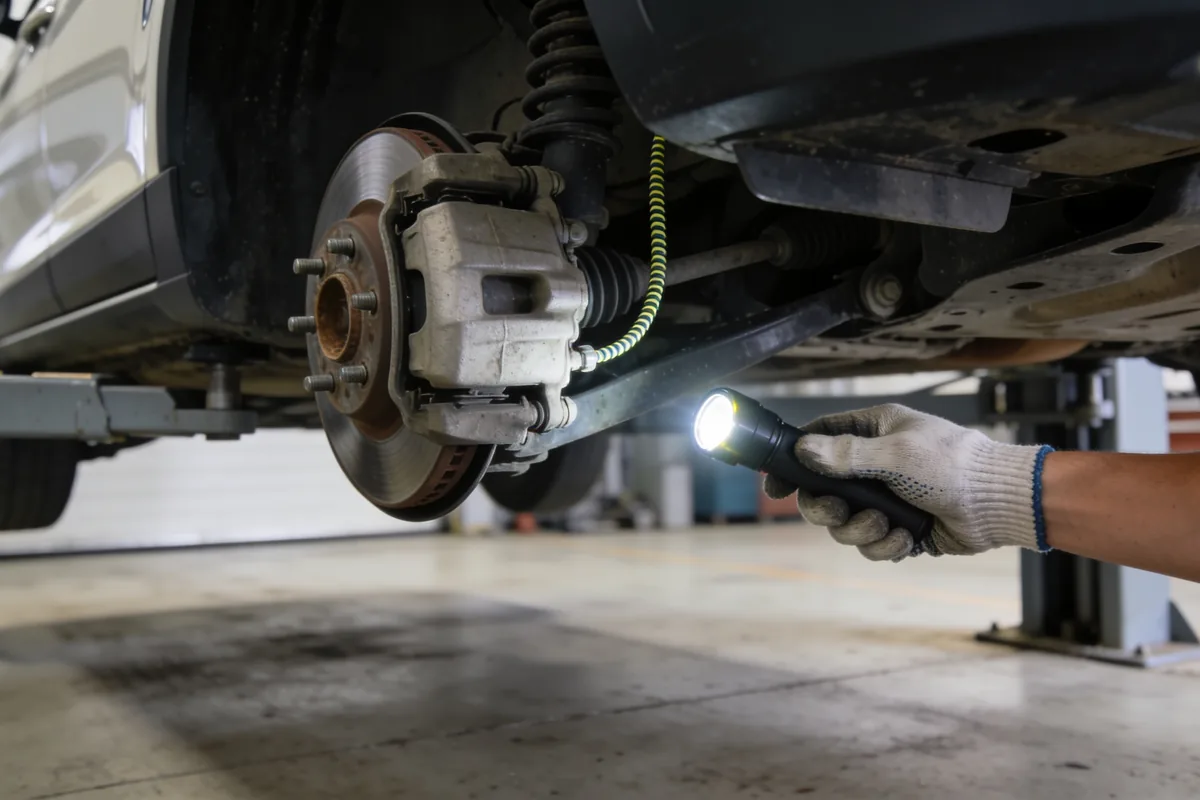
Structure comes first. The inspector looks at the body and chassis for significant rust, crash damage and sharp edges, the kind of structural problems that make a car unsafe in a crash rather than merely ugly. Steering and suspension come next, and this is where the car usually goes up on a hoist so the inspector can check bushes, ball joints, tie rods and leaks properly. Brakes are the third big group, because a car that cannot stop reliably has no business being registered. Wheels and tyres round out the big four, with tread depth, wear patterns and overall condition all getting a look.
Then comes the rest, and it is a longer list than most people expect:
- Seats and seatbelts, for condition and secure mounting
- Lights and reflectors, high beam and low beam, brake lights, indicators and number plate lights
- The windscreen and wipers, for cracks in the driver’s view and wipers that actually clear the glass
- The horn, the mirrors and the doors, along with the general operational checks
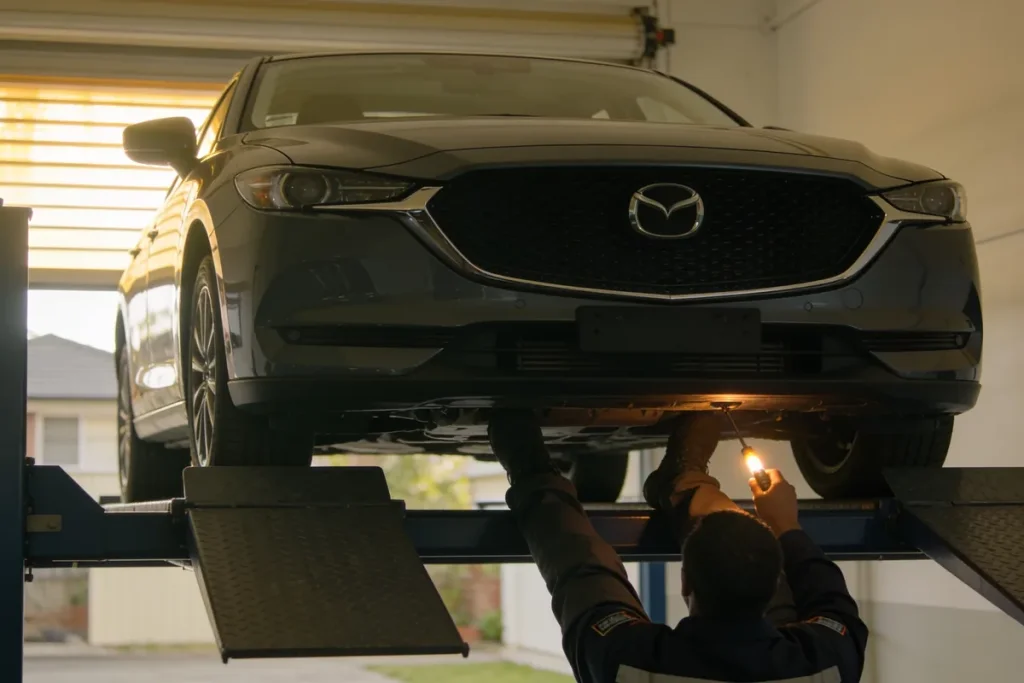
A proper inspection puts the car on a hoist, and that detail matters more than it looks. Some faults simply cannot be seen from above. A perished bush, a weeping shock absorber or a rusted brake line can be invisible until the car is in the air, and an inspector who checks from underneath is doing a different job from one who walks around the car on the ground. If you are wondering how a certificate could miss something your own mechanic later found, the hoist is usually the answer.
What can fail a roadworthy
The common failures are not exotic, and most of them are cheap to fix if you know about them before you buy. That is the quiet kindness of understanding the list: it turns a scary unknown into a set of ordinary repairs.
Worn or damaged tyres are probably the most common failure, and the easiest to spot yourself before you even involve an inspector. Brake issues are next, whether that is worn pads, a leaking line or a handbrake that does not hold. Significant rust or crash damage in structural areas will fail a car, as will leaking or worn suspension components that show up on the hoist. A cracked windscreen in the driver’s line of sight is a fail in most states, and so are lights that do not work and seatbelts that are damaged or do not retract.
The rules differ slightly by state, and the certificate names the authority that sets them, so treat this list as the shape of a roadworthy rather than a universal code. The point of knowing the common failures is not to scare you. It is so that when you read a roadworthy, you have a sense of what an inspector was actually looking at, and so that when you buy a car you know which small problems are worth fixing before you line up for your own certificate.
Choosing a station you can trust
Now for the decision the state government websites never help you with: how do you pick a station you can trust? It matters more than most buyers realise, because the certificate is only as good as the inspection behind it.
Start with the authority. Inspection stations are authorised or registered by the state body that sets the rules, whether that is VicRoads in Victoria, the Department of Transport and Main Roads in Queensland, or the equivalent in your state. The reliable way to pick is to start from your state’s own list of authorised stations rather than the first workshop that comes up in a search, because the list is the difference between a real inspection and a rubber stamp.
Then ask the questions that separate a thorough station from a busy one. Ask whether the car goes on a hoist as part of the check, because the underbody is where the faults that matter tend to hide. Ask whether you can be there while it happens, because a station that is happy to have you watch is usually a station that does the work properly. And be wary of the station that promises a pass before it has looked at the car. A genuine inspector cannot know a car will pass until they have inspected it, so a station that offers a guaranteed pass is telling you something about its standards, and it is not the good news it sounds like.
Read reviews with a grain of salt, the same way you would for any local business. One angry review is not a pattern, but five reviews all mentioning the same rushed job or the same missed fault are worth taking seriously. Local inspection stations are listed in local business directories, which is a fine place to build a shortlist, but the questions above are what turn a name into somewhere you would trust with your car.
When the roadworthy comes from the seller
Here is the scenario that most buyers meet, and the one that causes the most quiet anxiety: the seller hands you a roadworthy from their workshop, the one around the corner from where they bought the car. What should you make of it?
First, know that a roadworthy is tied to the vehicle, not the owner, and it generally travels with a sale. A valid certificate from the seller is not automatically suspicious. But it is only as good as the inspection behind it, and a certificate that missed something your own mechanic finds is worth questioning rather than accepting.
The honest advice for the car you are about to own is simple: get your own eyes on it. A separate pre-purchase inspection by an independent mechanic is the protection that matters when you are about to hand over a large amount of money, because it covers all the things a roadworthy does not, the gearbox, the engine, the things that cost real money when they fail. Think of the seller’s roadworthy as the seller’s opinion, and the independent inspection as your own.
If you genuinely believe a certificate is dodgy, if it was issued for a car that clearly should not have passed, the step is to contact the state authority. In Victoria that is VicRoads, in Queensland it is the Department of Transport and Main Roads, and every state has an equivalent body that takes the integrity of certificates seriously. A certificate is a legal document, and the authority behind it would rather hear about a bad one than have it quietly travel from owner to owner.
Costs and the practical stuff
The practical questions tend to come last, but they are the ones that decide whether you actually go through with a sale. A roadworthy inspection typically costs somewhere in the range of a few hundred dollars, depending on your state and the station, but treat that as an order of magnitude rather than a fixed price and confirm the current cost before you book.
A certificate also does not last forever. The validity period differs by state, so ask how long the certificate is good for and check the date on the one you are handed, because a certificate that has already lapsed is worth no more than the paper it is printed on.
For a private sale, the practical sequence is worth holding in your head. Do your own basic checks first, the tyres, the lights, the obvious things from the failure list above. If the car matters to you, get an independent pre-purchase inspection before you commit. And treat the certificate as one input to the decision, not the verdict on it. The certificate clears the safety bar. The inspection, the test drive and your own questions about the car’s history do everything else.
Treat the roadworthy as a starting point
So here is the warm summary, the part worth keeping. A roadworthy certificate is a safety floor, not a clean bill of health. The hoist is where the truth is, because some faults only appear when a car is in the air. And the station you can trust is the one that lets you watch, the one that puts your car on the hoist and does the job properly rather than promising an easy pass.
The certificate from the seller is a starting point, not the final word. For the car you are about to own, the protection that actually matters is your own pre-purchase inspection by an independent mechanic, and the state authority is there if you believe a certificate is not genuine.
One gentle action to end on. When the time comes, shortlist two or three local inspection stations, call each of them and ask whether the car goes on the hoist and whether you can be there while it happens. The one that says yes to both is the one to book. It is a small question, and it separates a thorough inspection from a rubber stamp better than almost anything else.
Sources: Transport Victoria / VicRoads, roadworthy certificates and what is checked · Queensland Government, safety certificates and roadworthy inspections · NSW Government, vehicle roadworthiness